Best ETFs to Invest in India: The Ultimate Passive Strategy
A step-by-step masterclass on tracking errors, sector rotation, and institutional passive frameworks.

Best ETFs to Invest in India: The Ultimate Passive Strategy
A step-by-step masterclass on tracking errors, sector rotation, and institutional passive frameworks.
In today's fast-evolving financial landscape, retail investors constantly search for the perfect balance between high returns and low risks. Finding the best ETFs to invest in India offers a clean, reliable, and institutional-grade roadmap toward long-term wealth building.
While high-leverage derivatives like Futures and Options (F&O) often lead to rapid capital destruction, major state institutions like the Employees' Provident Fund Organisation (EPFO) systematically allocate billions directly into passive market instruments. Under the EPFO ETF investment rules, around 8.70% of its massive retirement corpus goes directly into reliable benchmark index funds.
This strong institutional conviction proves that exchange-traded funds serve as durable vehicles for sustainable wealth accumulation.
Step 1: Understand the ETF vs Mutual Fund Expense Ratio to Optimize Returns
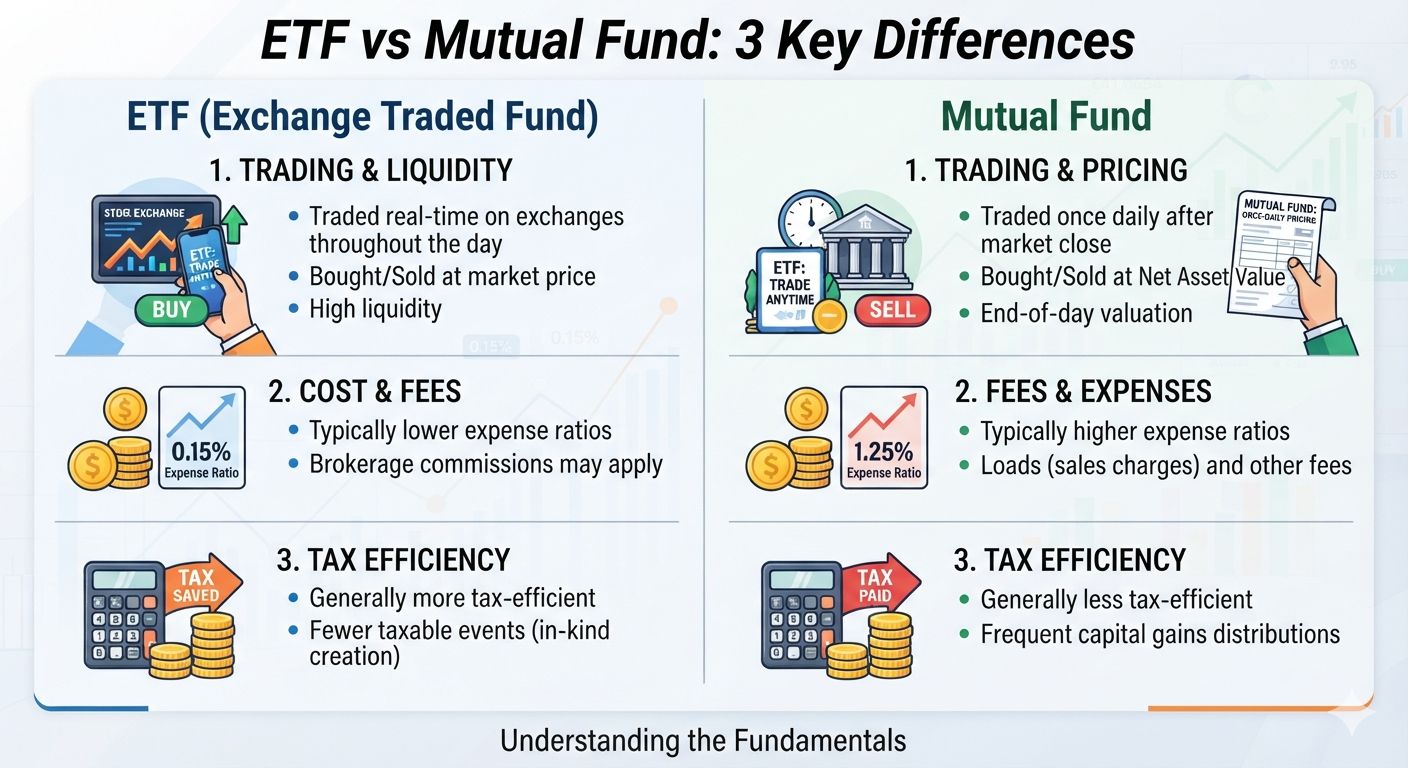
The primary differentiator between an exchange-traded asset and an actively managed fund is the structural drag caused by ongoing operational management fees.
When evaluating the ETF vs mutual fund expense ratio, active schemes charge between 0.20% and 2.0%, whereas a low-cost Nifty 50 ETF list fund operates with negligible fees as low as 0.04%. Over a 20-year horizon, higher fee structures can erode individual portfolio wealth by ₹2.70 Lakh to ₹22 Lakh compared to identical market performance.
Expense Ratio Impact Comparison
Investment Vehicle | Average Expense Ratio | 20-Year Wealth Loss |
Nifty 50 ETF List | 0.04% | Benchmark Baseline (0) |
Direct Index Mutual Fund | 0.20% | ₹2,70,000 |
Active Large-Cap Fund | 0.80% | ₹12,000,000 |
Active Large-Cap Regular Fund | 1.50% | ₹22,000,000 |
Step 2: Deploy a Sector Rotation Strategy Using ETFs for Alpha Generation
Capital rotates continuously through distinct industries like banking, IT, auto, and infrastructure in cyclical macroeconomic waves. Astute wealth managers maximize portfolio returns by deploying a sector rotation strategy using ETFs.
By identifying technical chart breakouts in specific sector indices—such as software—you can acquire a dedicated Nifty IT sector ETF investment to capture entire upward sector momentum without stock-picking risk.
Neutralizing Idiosyncratic Risk
Single-company investments expose capital to corporate operational failures, management shocks, or earnings drops. Purchasing broad industry buckets fully neutralizes individual company risk while retaining exposure to macroeconomic expansion.
Individual Stock Trading: Maintains high exposure to poor corporate management, vulnerable to sudden earnings shocks, and burdened by heavy idiosyncratic risk.
Sector ETF Framework: Fully diversified across the entire industry index, captures broad market momentum trends, and mitigates systematic volatility.
Step 3: Analyze If ETF Trading Is Safer Than F&O Derivatives
The derivatives segment remains structurally perilous for retail participants due to high leverage, time decay (theta), volatile margin calls, and heavy transaction taxes. Asking is ETF trading safer than F&O highlights massive structural safety advantages.
Swing trading liquid equity index blocks through standard Demat accounts provides a stress-free framework. Traders can execute trendline breakout patterns without expiration pressures, leverage decay, or overnight margin volatility.
Simplified Access to Commodities
Historically, investing in gold or silver meant dealing with physical storage security or navigating derivative contracts. Commodity ETFs track underlying asset spot prices perfectly, allowing investors to add gold or silver allocations with a single click.
Step 4: Understand Risk Metrics and What Is Tracking Error in ETF Wrappers
Despite high structural efficiency, exchange-traded products carry technical friction points that require verification prior to capital deployment:
Liquidity Deficits: Avoid low-volume options where wide bid-ask spreads create gaps between market price and Net Asset Value (NAV), forcing high entry premiums.
Tracking Error Variances: Understanding what is tracking error in ETF assets reveals how well a fund replicates its benchmark index. Lower deviation scores indicate superior management.
Index Reshuffling Friction: While large-cap indices automatically filter failing firms, mid-cap and small-cap indices incur higher rebalancing turnover fees.
Step 5: Run the Pre-Investment Selection Checklist Protocol
Before placing buy orders, execute these mandatory screening protocols:
A. The ETF Liquidity Screening Rules
Daily Trading Volume: Filter exclusively for funds maintaining a minimum daily trading volume of 100,000 shares or a daily turnover exceeding ₹50 Lakhs.
How to Calculate ETF Bid-Ask Spread: Examine live market depth windows to ensure the spread between highest buyer bid and lowest seller ask remains under 0.05%.
iNAV vs Market Price ETF Discrepancies: Monitor real-time indicative NAV (iNAV vs market price ETF). Abort order entry if market price deviates by more than 0.10%.
B. Tracking Error Validation Protocol
Review the fund factsheet's 1-year and 3-year rolling annualized tracking errors. For core products like Nifty 50, reject schemes showing tracking errors above 0.15%.
Step 6: Know When to Choose Low-Cost Index Funds India Over ETFs
While the passive segment is growing rapidly, choosing low-cost index funds India remains preferable when building automated, long-term Systematic Investment Plans (SIPs) without broker terminal dependency.
For core large-cap and sector momentum strategies, liquid ETFs remain the premier tool for disciplined wealth creation.
Conclusion
Achieving market-beating returns does not require speculative trading. By following institutional playbooks, managing tracking errors, and leveraging low-cost ETFs, retail investors can build compounding multi-generational wealth.
Disclaimer
This publication is provided strictly for educational and informational purposes only and does not constitute financial, investment, or legal advice. Financial markets carry inherent volatility, and past performance is not indicative of future returns. Readers should conduct independent due diligence and consult a certified financial advisor prior to allocating capital.

CFA, MBA and former corporate CFO with 18 years of global financial experience across the US, UK and India. Sasikumar writes jargon-free, actionable guides on mutual funds, ETFs and retirement planning for Indian investors.