Best ETFs for Long Term Investment in India
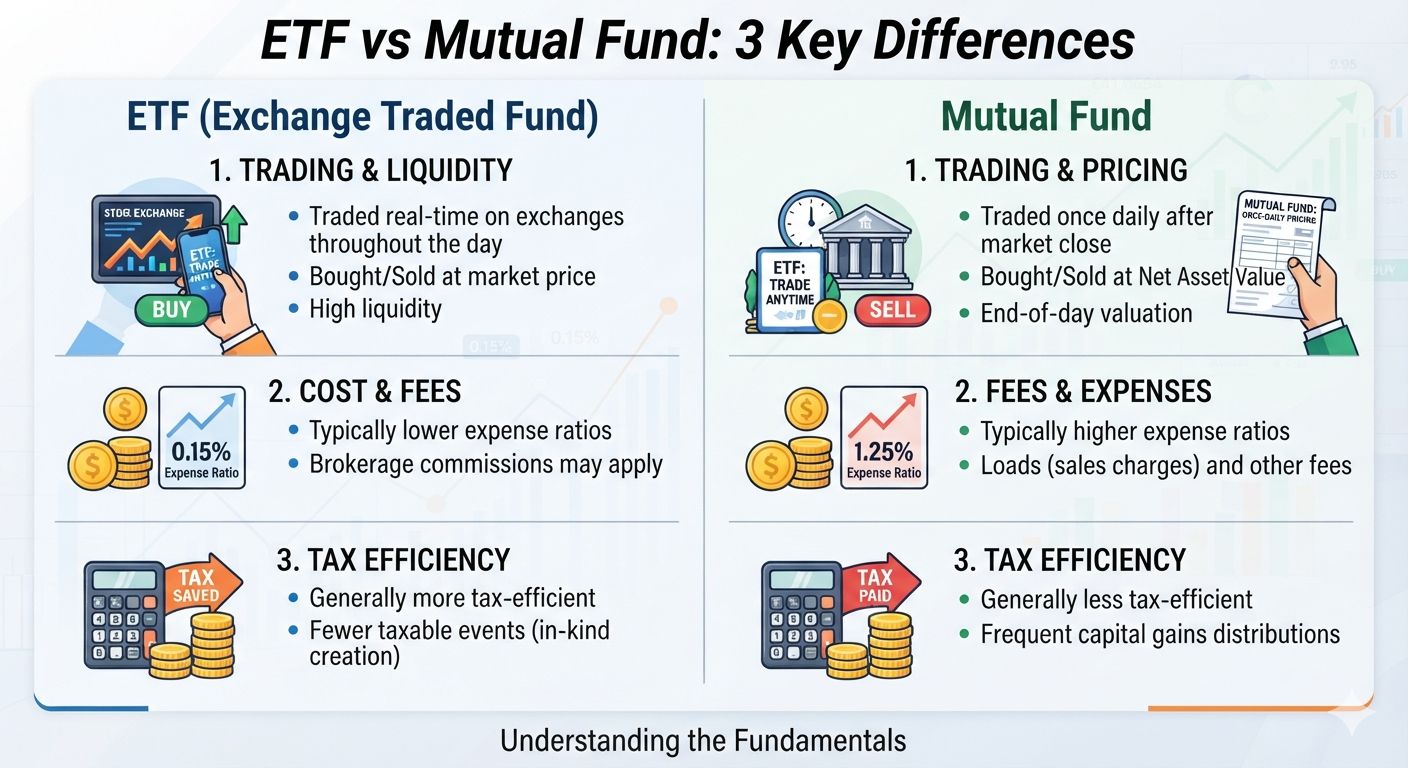
Unlike traditional mutual funds, ETFs trade on public stock exchanges at live market prices throughout the trading session. This high liquidity enables investors to capitalize on short-term market dips and execute precise portfolio rebalancing strategies effortlessly.

Best ETFs for Long Term Investment in India
Exchange-Traded Funds (ETFs) have revolutionized retail investing by offering real-time market trading combined with instant asset diversification. When building a resilient financial strategy, selecting the right Best ETFs for Long Term Investment in India can dramatically reduce individual stock risk while providing consistent, inflation-beating long-term growth.
4 Key Rules Before Buying Any ETF Strategy
Before allocating capital to any fund, smart investors conduct a rigorous evaluation based on four fundamental metrics. Applying these criteria ensures you minimize hidden costs and execute trades at fair market value.
High Market Liquidity: Robust trading volume ensures you can easily enter and exit positions without experiencing wide bid-ask spreads or extreme price slippage.
Low Expense Ratio: Annual management fees directly reduce overall compound interest. Prioritizing funds with ultra-low expense ratios keeps more capital working in your account.
Minimal Tracking Error: A lower tracking error indicates that the fund effectively replicates its underlying benchmark index without unnecessary drag or mismanagement.
Indicative Asset Value (iNAV) Verification: Always cross-check the real-time iNAV fair value on official exchange websites like the NSE before placing an order. Purchasing an ETF trading significantly above its iNAV means paying an unnecessary valuation premium.
Pro Investor Tip: If an ETF has an iNAV of ₹100 but trades at ₹125 on the open exchange, you are paying an unneeded ₹25 premium. Always execute orders as close to the official iNAV benchmark as possible. |
Overview Comparison: Best ETFs for Long Term Investment in India
The table below provides a side-by-side technical breakdown of all 7 featured ETFs, comparing key parameters including asset class, AUM, expense ratios, and historical returns.
ETF Name | Category / Index | AUM (₹ Cr) | Expense Ratio | 1-Yr Return | 3-Yr / Historic CAGR |
Tata Gold ETF | Precious Metals (Gold) | ₹5,631 | 0.05% | 46.00% | 12-13% Historical |
Mirae Asset Nifty Midcap 150 ETF | Domestic Mid-Cap | ₹1,763 | 0.05% | 6.81% | 20.51% (3-Yr) |
HDFC Nifty Smallcap 250 ETF | Domestic Small-Cap | ₹251 | 0.21% | 2.20% | 19.26% (3-Yr) |
Motilal Oswal Nasdaq 100 ETF | US Large-Cap Tech | ₹14.12 | 0.50% | 45.37% | 23.95% (Inception) |
Bharat 22 ETF | PSU & Blue-Chip | ₹1,383 | 0.06% | 6.07% | 20.11% (3-Yr) |
HDFC Silver ETF | Precious Metals (Silver) | ₹7,574 | 0.42% | >100.00% | 44.34% (3-Yr) |
Mirae Asset FANG+ ETF | US Mega-Tech Concentrated | ₹4,258 | 0.60% | 31.09% | 26.50% (Inception) |
Detailed Analysis: Best ETFs for Long Term Investment in India
The following curated basket spans domestic equities, global technology leaders, small-cap growth, and precious metals. Integrating these assets provides optimal risk-adjusted returns across varying macroeconomic cycles.
1. Tata Gold ETF: Safe-Haven Precious Metals Portfolio Anchor
Gold serves as a time-tested hedge against inflation and systematic market volatility. Integrating gold allocation into a core investment strategy provides essential downside stability during turbulent market cycles.
Historically, physical gold has delivered a reliable CAGR of 12–13%, making it a highly effective store of value. The Tata Gold ETF offers liquid exposure with a massive 46% return over the past year.
Asset Under Management (AUM): ₹5,631 Crore
Expense Ratio & Tracking Error: 0.05% Expense Ratio | 0.41% Tracking Error
Portfolio Allocation: 97.24% Physical Gold Bullion | 2.76% Cash Reserves
2. Mirae Asset Nifty Midcap 150 ETF: Core Mid-Cap Growth Strategy
Mid-cap equities occupy the ideal sweet spot between proven large-cap stability and high-growth small-cap potential. Most active fund managers consistently struggle to outperform this broad mid-cap index baseline.
With a stellar 10-year historic CAGR near 18%, this benchmark offers exceptional wealth compounding. The Mirae Asset Nifty Midcap 150 ETF tracks 150 emerging enterprise leaders across dynamic economic sectors.
AUM & Inception: ₹1,763 Crore | Launched in 2022
Key Efficiency Metrics: 0.05% Expense Ratio | 0.05% Tracking Error
Historical Performance: 20.51% 3-Year Return | 6.81% 1-Year Return
3. HDFC Nifty Smallcap 250 ETF: Aggressive Capital Appreciation
For investors targeting aggressive long-term capital expansion, small-cap companies offer explosive growth potential. A single allocation provides direct ownership in 250 high-growth small-cap enterprises.
Over the past decade, the small-cap index has compounded at roughly 15.50% CAGR. This fund provides broad market exposure while successfully eliminating single-stock bankruptcy risks.
AUM & Inception: ₹251 Crore | Launched in 2023
Efficiency Metrics: 0.21% Expense Ratio | 0.08% Tracking Error
Performance Track Record: 19.26% 3-Year CAGR | 2.20% 1-Year Return
4. Motilal Oswal Nasdaq 100 ETF: US Tech Giant Diversification
International geographic diversification protects your domestic wealth from single-country economic downturns. This index fund provides targeted exposure to the top 100 non-financial giants listed on the US Nasdaq exchange.
Delivering an astounding 23.95% CAGR since inception, it stands as a premier global wealth builder. Investors should monitor market pullbacks closely, as it currently trades at a noticeable premium over its fair iNAV value.
Time Horizon
CAGR / Return (%)
1-Year Return
45.37%
3-Year CAGR
31.72%
5-Year CAGR
20.84%
10-Year CAGR
24.94%
Since Inception CAGR
23.95%
AUM & Inception: ₹14.12 Crore | Launched in 2011
Expense Ratio: 0.50%
5. Bharat 22 ETF: Concentrated PSU Industry Leaders
Value investors seeking exposure to government-backed public sector undertakings (PSUs) and blue-chip leaders will find strong fundamentals here. This specialized basket contains 22 dominant state-owned and private enterprises.
Featuring flagship holdings like Larsen & Toubro, ITC, NTPC, State Bank of India, Axis Bank, Power Grid, and Coal India, it offers stable dividend yields along with steady capital gains.
AUM & Inception: ₹1,383 Crore | Launched in 2017
Expense Ratio: 0.06% (Extremely Low Cost Structure)
Historical CAGR: 5-Yr CAGR: 23.99% | 3-Yr CAGR: 20.11% | 1-Yr Return: 6.07%
6. HDFC Silver ETF: Strategic Precious Metal Commodity Allocation
Industrial demand for silver continues to accelerate due to global solar energy expansion and electronics manufacturing. Alongside gold, silver represents a high-upside alternative commodity investment.
The HDFC Silver ETF provides direct price exposure without physical storage or purity concerns. It has demonstrated extraordinary momentum, generating over 100% returns in the past single year.
AUM & Inception: ₹7,574 Crore | Launched in 2022
Expense & Tracking: 0.42% Expense Ratio | 0.64% Tracking Error
Performance Track Record: 3-Year CAGR: 44.34% | 1-Year Return: >100%
7. Mirae Asset FANG+ ETF: Concentrated Global Tech Monopoly Growth
For aggressive growth investors seeking direct ownership in mega-cap global technology monopolies, the FANG+ index is unmatched. It concentrates capital into 10 highly influential global technology innovators.
Key constituents include NVIDIA, Microsoft, Apple, Amazon, Alphabet (Google), Meta, Broadcom, Micron Technology, Palantir, and Netflix. Since inception, this fund has compounded at a spectacular 26.50% CAGR.
Time Period | CAGR / Return (%) |
1-Year Return | 31.09% |
3-Year CAGR | 37.54% |
5-Year CAGR | 24.80% |
Since Inception CAGR | 26.50% |
AUM & Inception: ₹4,258 Crore | Launched in 2021
Expense Ratio: 0.60%
Portfolio Construction: How to Allocate Capital Across Top 7 ETFs
Building a resilient long-term strategy requires combining defensive assets with aggressive growth drivers. Diversifying across gold, domestic equity, and international technology creates a balanced risk profile.
Investors should systematically dollar-cost average into these positions while keeping cash reserves to buy structural dips. Always review tracking errors and iNAV pricing quarterly to maintain cost efficiency.
Asset Category | Recommended ETF | Suggested Allocation (%) | Investment Role |
Precious Metals (Defensive) | Tata Gold ETF / HDFC Silver ETF | 15% - 20% | Inflation Hedge & Volatility Cushion |
Core Domestic Equities | Mirae Midcap 150 / HDFC Smallcap 250 / Bharat 22 | 45% - 50% | Primary Compound Growth Engine |
International Technology | Motilal Nasdaq 100 / Mirae FANG+ ETF | 30% - 35% | Global Monopoly Growth & Currency Hedge |
Financial Advice Disclaimer
This article is for informational and educational purposes only and does not constitute personalized financial, investment, or legal advice. Financial markets are subject to price volatility and risk of capital loss. Past historical performance and CAGR returns are not indicative of future results. Always conduct independent thorough research or consult with a certified professional financial planner before executing any trade or investment decision.

CFA, MBA and former corporate CFO with 18 years of global financial experience across the US, UK and India. Sasikumar writes jargon-free, actionable guides on mutual funds, ETFs and retirement planning for Indian investors.