Mutual Funds Explained: A Simple, Complete Guide
Easy answers on how funds work, SIP vs. lumpsum, growth vs. dividend, and how many funds you really need

Mutual Funds Explained: A Simple, Complete Guide Easy answers on how funds work, SIP vs. lumpsum, growth vs. dividend, and how many funds you really need |
Most investors ask the same questions sooner or later. What happens to your money if a mutual fund company shuts down? Is an index fund better than an ETF? Should you always pick growth over dividend?
These are simple but important questions. Mutual funds are one of the easiest ways to grow your money over time. But with so many types, plans, and options, it can feel confusing.
This guide answers these questions in plain language. It covers what mutual funds are, how they keep your money safe, the different types available, and simple choices like SIP vs. lumpsum and direct vs. regular plans. By the end, you will know exactly how to think about your mutual fund investments.
01 | What Is a Mutual Fund? |
Imagine you need to travel from one city to another by air. You have three choices: rent a private jet, buy your own plane, or simply buy a ticket on a normal flight. Almost nobody can afford the first two options. Buying a ticket is easy and affordable for everyone.
Mutual funds work the same way. A very wealthy person can hire a full-time expert, called a fund manager, to manage their money. Most people cannot afford this. So instead, many people put their money together, and one expert manages it for all of them. This is what makes a mutual fund affordable for everyone.
This shared money is managed by a company called an Asset Management Company (AMC). The AMC picks a fund manager to decide where to invest the money. In return, the AMC charges a small fee, called the expense ratio. This fee is usually less than 1% of your money.
So if you invest ₹1,000 a month, you pay only a few rupees as fees. In return, you get help from experts who would normally charge a salary of ₹50 lakh to ₹1 crore a year. This is why mutual funds work so well: expert help at a very low cost, with no extra paperwork for you.
02 | Why Choose Mutual Funds? |
There are two main reasons to invest in stocks (also called equities). First, over many years, stocks have given higher returns than gold or real estate. Second, stocks are easy to buy and sell. Real estate can take months to sell, and gold has its own costs.
The risk with stocks is that they can go up or down a lot. If you pick the wrong stocks, you can lose a lot of money. If you pick well, you can earn a lot.
This is where mutual funds help. A diversified fund spreads your money across many companies. This protects you from the worst losses, while still giving you the benefit of expert stock-picking and low cost.
03 | What If the Fund Company Shuts Down? |
A common worry is that a mutual fund company could shut down or run away with your money, like some unregulated chit funds did in the past. The good news is that mutual funds are built to prevent exactly this.
The AMC only decides where to invest your money. It never actually holds your money. Your money is held by a separate, government-registered trust. The stocks and bonds bought with your money are kept safe by a custodian, which is a different, closely-watched institution.
So if an AMC shuts down overnight, your stocks and bonds are still safe and still worth the same amount, because their value comes from the companies, not from the AMC. A new company usually takes over managing the fund. This may cause a delay of a few weeks or months, but your money is not lost.
04 | Types of Mutual Funds |
Stock Fund Types, From Safer to Riskier
There are many types of stock (equity) funds. The right one depends on how much risk you are comfortable taking:
Large cap funds — invest in big, well-known companies. One of the safer choices.
Large & mid cap and mid cap funds — medium risk, medium reward.
Small cap funds — the riskiest type of stock fund.
Sector funds — invest in one industry only. They do well when that industry does well, and poorly when it doesn't.
Value and focused funds — look for stocks that seem cheap or under-the-radar.
Flexi cap and multicap funds — invest in companies of all sizes, big and small.
ELSS funds — help you save on tax while investing in stocks.
Active Funds, Index Funds, and ETFs
An active fund is like a car with a driver. How well it does depends on the fund manager's skill. An index fund is different. It simply copies a list of top companies, like the Nifty 50, and buys the same companies in the same amounts.
This means an index fund will never do much worse than the overall market. But it will also never do much better. If you're happy matching the market's return, choose an index fund. If you want a chance at higher returns and are willing to take more risk, choose an active fund.
ETFs (Exchange Traded Funds) work like index funds but are bought and sold like stocks, through a demat account. Their price changes all day. ETFs suit people who already trade stocks often. For most long-term investors, plain index funds are simpler.
Debt Funds, Hybrid Funds, and Fund-of-Funds
Debt funds invest in safer instruments like bonds instead of stocks. They are grouped by how long the bonds they hold will take to mature, not by how long you need to stay invested. This is a less useful category for most everyday investors.
Hybrid funds mix stocks, bonds, and sometimes gold in one fund. This saves you from deciding how to split your money. The downside is that these funds usually charge slightly higher fees.
Fund-of-funds solve a different problem. Since there are thousands of mutual funds to choose from, a fund-of-funds picks a handful of good funds for you, so you don't have to choose yourself.
05 | Growth Option vs. Dividend Option |
Most funds let you choose between two options. In the dividend option, any profit the fund earns is paid out to you in small amounts now and then. This money is also taxed.
In the growth option, that same profit stays inside the fund and keeps growing your investment automatically. You avoid extra tax, and your money compounds faster over time. For most long-term investors, the growth option is the better choice.
06 | Regular Plan vs. Direct Plan |
A regular plan includes a fee paid to an advisor or agent who helps you invest. A direct plan skips this middleman. Because there's no fee to pay them, your returns are slightly higher.
Some people think a regular plan is better if its price per unit, called NAV, is lower than the direct plan's. This is wrong. Your returns depend on how much money you put in, not how many units you own.
If the direct plan grows faster than the regular plan, your money will grow faster in the direct plan, no matter what the current price per unit is. If you're comfortable choosing funds yourself and don't need ongoing advice, a direct plan usually makes more sense.
07 | Does a Lower Price Per Unit Mean a Better Deal? |
Say one fund costs ₹500 per unit and another costs ₹10 per unit. Many people assume the cheaper one is a better deal because it buys more units. This is not true.
What matters is how much your total money grows, not how many units you hold. If a fund grows by 20%, your ₹1,000 becomes ₹1,200, whether that ₹1,000 bought you one unit or a hundred units.
Instead of looking at price per unit, look at the fund's past performance, how consistent it has been, how it compares to similar funds, and how it has done in both good and bad markets.
08 | SIP vs. Lumpsum: Which Is Better? |
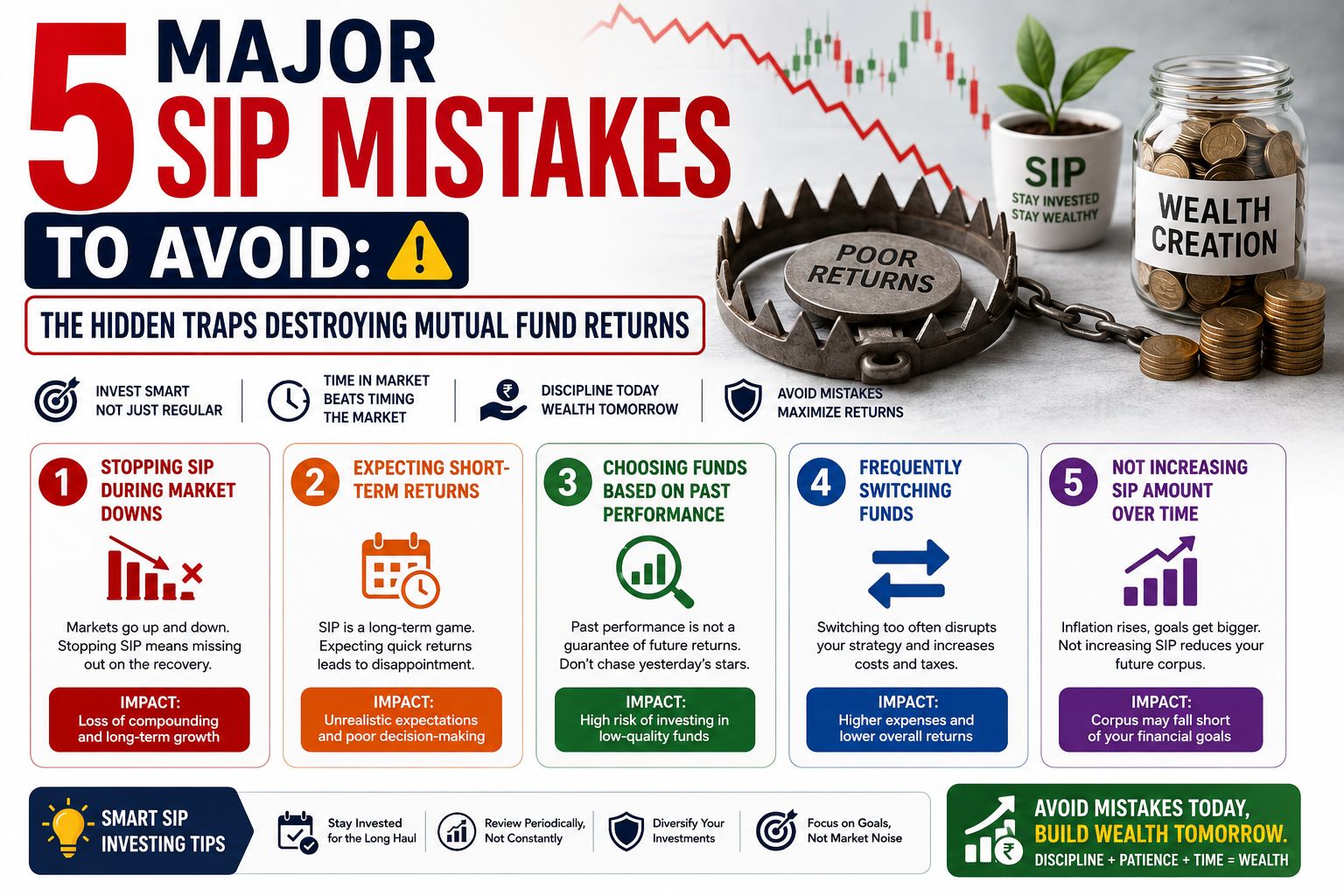
When markets fall, some people feel their SIP (Systematic Investment Plan) failed to protect them. They think it would have been better to save cash and invest it only when prices are low. This idea misses how a SIP actually works.
With a SIP, you invest a fixed amount every month automatically. When prices are high, you buy fewer units. When prices are low, you buy more units. Over time, this evens out your average cost, without you having to guess when prices are low.
Because a SIP keeps investing steadily, you also don't miss sudden, sharp jumps in the market that are impossible to predict. Trying to guess the right time to invest often means missing these jumps entirely.
09 | How Your Own Timing Affects Your Returns |
A fund manager can only buy stocks once you and other investors put money in. If you invest when the market is low, the fund manager gets to buy good stocks at good prices. If you invest when the market is at its peak, the manager is forced to buy at high prices, since rules don't allow funds to hold too much cash.
The same applies when you take money out. If you withdraw during a market crash, the fund manager may be forced to sell stocks at low prices just to pay you. So buying at the peak and selling during a crash can hurt your returns, even if the fund itself is a good one.
10 | Common Mistakes to Avoid |
Watch Out for New Fund Launches
A fund company only earns steadily if people keep investing in it, not necessarily if the fund performs well. This is why some companies close funds that are doing poorly and launch a New Fund Offer (NFO) instead, often marketed heavily with higher fees at the start.
Be cautious of fund companies that keep launching new funds or repeatedly shut down and relaunch old ones. This often means they care more about collecting money than managing it well.
Don't Try to Time the Market
Selling everything when the market is high and buying back when it's low sounds smart, but every sale comes with tax and other costs. These costs add up over time. It is usually better to stay invested and only add extra money during a downturn, rather than pulling out what you already have.
How Many Funds Do You Really Need?
A single fund usually holds anywhere from 25 to 100 different companies. So owning just two to four good funds already gives you plenty of variety. Some investors end up owning dozens, even over 100 different funds, which only adds confusion without adding real benefit.
Key Takeaways
|
11 | Putting It All Together |
Mutual funds work well because they combine expert help, safety, and low cost in one simple product. But a few small details make a big difference: knowing your money is legally separate from the fund company, picking growth and direct plans where it makes sense, and understanding that a low price per unit is not a bargain.
The best results usually come from choosing a few good funds, investing regularly through a SIP, and staying invested through ups and downs instead of trying to time the market. With these simple habits, mutual funds can be one of the easiest ways to grow your money over time.
Disclaimer: The content provided in this blog post is intended strictly for general educational purposes and does not constitute financial, legal, tax, or investment advice. The author is not registered with the Securities and Exchange Board of India (SEBI) or any other regulatory authority as a certified investment advisor. All data, opinions, and analysis presented are based on personal studies and perceptions at the time of writing. Past performance is not indicative of future results. Every investor must perform independent due diligence or seek professional advice from a competent certified authority prior to deploying capital.

CFA, MBA and former corporate CFO with 18 years of global financial experience across the US, UK and India. Sasikumar writes jargon-free, actionable guides on mutual funds, ETFs and retirement planning for Indian investors.