4 Investment Paths to Financial Freedom for Low-Salaried Professionals
Building substantial wealth does not require a six-figure income. Even on a modest monthly budget, strategic financial choices can transform modest savings into significant capital over time.
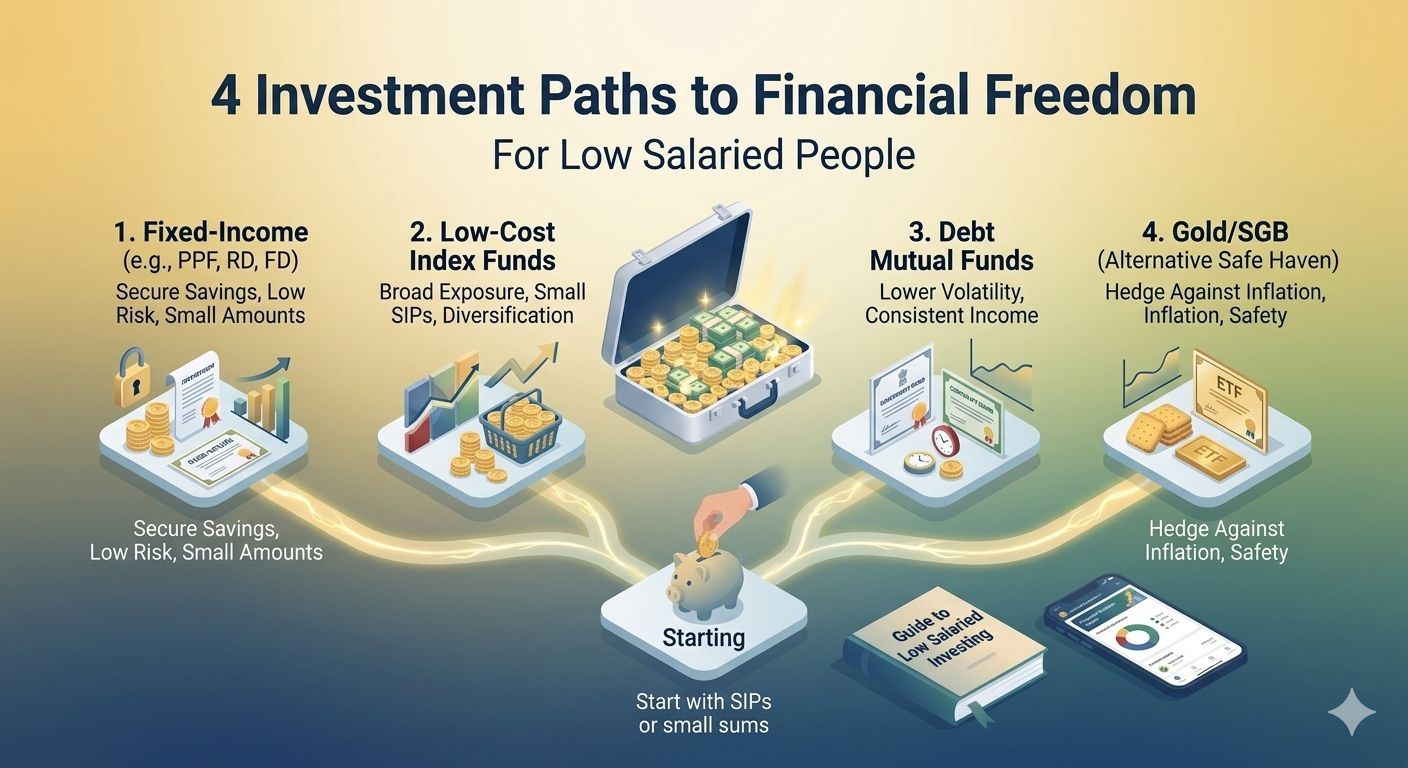
4 Investment Paths to Financial Freedom for Low-Salaried Professionals
The modern financial reality for many young professionals is frustrating. Monthly salaries arrive, only to immediately disappear into food delivery apps, luxury subscriptions, and non-essential consumer electronics. Achieving financial freedom for low-salaried professionals has become more important than ever before
The remaining balance is often handled with a passive mindset. However, achieving financial freedom for low-salaried professionals is entirely achievable when you apply the power of compound interest and disciplined allocation.
Whether you can set aside ₹3,000 or ₹5,000 every month, choosing the right asset allocation model determines whether your money merely survives inflation or builds true wealth over time..
Visualizing Wealth Growth Across Strategies
The chart below illustrates the growth trajectory of a monthly ₹3,000 investment over a 40-year horizon across conservative, balanced, and aggressive investment vehicles.

Master Investment Strategy Comparison (₹3,000 / Month Investment)
Strategy / Asset Class | 10 Years | 20 Years | 30 Years | 40 Years | Risk Profile |
1. Fixed Deposits (6% Return) | ₹5 Lakh | ₹33 Lakh | ₹1 Crore | ₹3.3 Crore (Real: ~₹50L) | Low / Capital Safe |
2. Mutual Funds / Index | ₹9 Lakh | ₹63 Lakh | ₹3.5 Crore | ₹14 Crore | Moderate |
3. High-Risk Portfolio | ₹10 Lakh | ₹1 Crore | ₹6.7 Crore | ₹40 Crore | High / Volatile |
4. Self-Investment | Exponential Income Multiplier (Skill Capital) | Exponential Income Multiplier (Skill Capital) | Exponential Income Multiplier (Skill Capital) | Exponential Income Multiplier (Skill Capital) | Uncapped Growth |
1. Fixed Deposits: The Low-Risk Emergency Reserve
Fixed Deposits (FDs) remain a traditional favorite due to their guaranteed returns and capital preservation. However, viewing FDs as a primary vehicle for wealth generation is a strategic mistake due to inflation.
FD Returns & Inflation Projection (₹3,000 / Month Investment)
Time Horizon | Nominal Corpus Value | Real Purchasing Value (Adjusted for Inflation) |
10 Years | ₹5 Lakh | ₹3.5 Lakh |
20 Years | ₹33 Lakh | ₹12 Lakh |
40 Years | ₹3.3 Crore | ₹50 Lakh |
Key Takeaway: FDs excel as emergency funds for short-term liquidity, but they are inefficient for long-term wealth creation. |
2. Index Funds & Mutual Funds: The Smart Middle Path
For balanced growth without extreme volatility, broad-market index funds and mutual funds represent the optimal strategy for core portfolio expansion leveraging compound interest.
Asset Allocation Breakdown
Asset Category | Recommended % | Target Strategy |
Broad Market Index (e.g. Nifty 50) | 70% | Long-term market stability |
Mid-Cap Index Funds | 20% | Balanced growth opportunities |
Small-Cap Index Funds | 10% | Controlled capital appreciation |
FD vs. Mutual Fund Growth Comparison (₹3,000 / Month)
Investment Horizon | Fixed Deposit (6% p.a.) | Index / Mutual Funds |
10 Years | ₹5 Lakh | ₹9 Lakh |
20 Years | ₹33 Lakh | ₹63 Lakh |
30 Years | ₹1 Crore | ₹3.5 Crore |
40 Years | ₹3.3 Crore | ₹14 Crore |
A disciplined ₹5,000 monthly SIP maintained over 25 years accumulates a corpus of approximately ₹4 crore in Mutual Funds versus ₹70 lakh in an FD.
3. High-Risk Aggressive Portfolios: High Volatility, High Return
Investors with a long time horizon and high risk tolerance can adopt an aggressive allocation model targeted at early-stage high-growth enterprises.
Aggressive Portfolio Allocation & Growth Trajectory
Allocation Mix | Horizon | Projected Wealth Corpus |
70% Small-Cap / 20% Mid-Cap / 10% Index | 10 Years | ₹10 Lakh |
70% Small-Cap / 20% Mid-Cap / 10% Index | 20 Years | ₹1 Crore |
70% Small-Cap / 20% Mid-Cap / 10% Index | 30 Years | ₹6.7 Crore |
70% Small-Cap / 20% Mid-Cap / 10% Index | 40 Years | ₹40 Crore |
4.Self-Investment: The Uncapped Growth Multiplier
Personal competency provides the highest guaranteed return on investment. Specialized skills remain permanently valuable regardless of market cycles.
Skill Allocation Matrix
Investment Channel | Target Outcome | Compounding Benefit |
Up-skilling & Software Courses | Career advancement & technical mastery | Direct salary multiplier |
Analytical Books & Media | Financial literacy & strategic thinking | Long-term decision quality |
Networking & Conferences | High-value business connections | Access to unadvertised opportunities |
Conclusion
Financial outcomes are dictated by strategy and execution rather than starting income. While conservative assets secure short-term liquidity, disciplined stock market indexing and continuous self-investment drive true multi-generational wealth.
Disclaimer
The information provided in this article is for educational and informational purposes only and does not constitute formal financial, investment, or legal advice. Financial markets are subject to risk, and past performance is not indicative of future returns. Readers should conduct independent research or consult with a qualified financial advisor before making any investment decisions.

CFA, MBA and former corporate CFO with 18 years of global financial experience across the US, UK and India. Sasikumar writes jargon-free, actionable guides on mutual funds, ETFs and retirement planning for Indian investors.