ETFs vs. Index Funds
Nifty 50 ETF vs Index Fund — compare real returns, hidden transaction costs, and expense ratios with actual data to pick the smarter passive investment
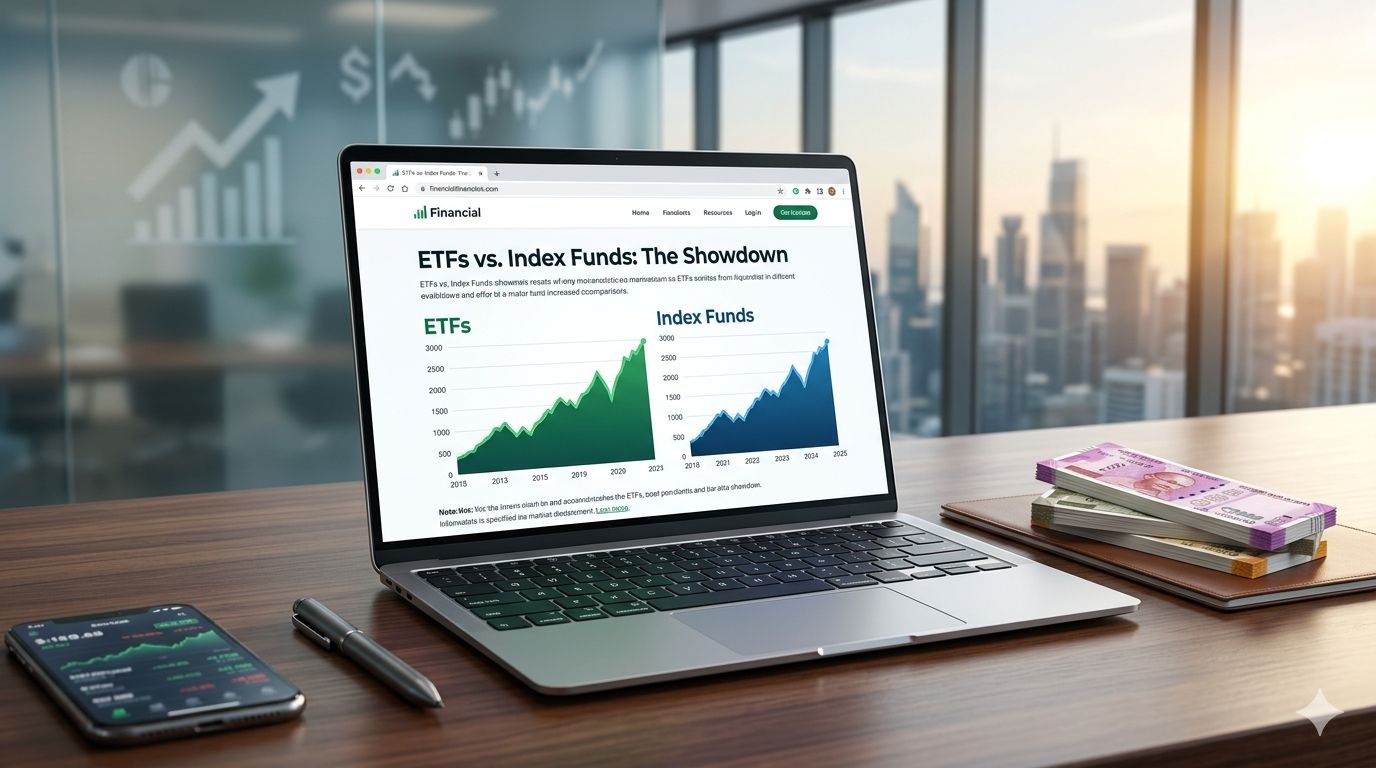
ETFs vs. Index Funds
Where Can You Actually Earn Higher Returns?
If you ask a room of investors whether ETFs or Index Funds generate more wealth, you will get highly divided answers. Many rely on basic internet searches or surface-level point-to-point returns.
However, looking strictly at the listed CAGR on a chart doesn't tell the full story. While both instruments track the exact same underlying market indices, they operate under fundamentally different mechanics.
This comprehensive guide takes a data-driven, practical look into the structural differences, hidden transaction costs, and actual real-world performance metrics of ETFs versus Index Funds.
01Historical Returns: Analyzing the Raw Data
To set up an accurate comparison, we evaluate two passive instruments from the same asset manager both tracking the Nifty 50 Index: a standard Nifty 50 ETF (e.g., Nifty BeES) and a corresponding Nifty 50 Index Fund.
Performance Data Breakdown
Time Horizon | ETF (Nifty BeES) | Index Fund |
1-Year | ~11.03% | ~12.06% ↑ |
3-Year | ~14.36% ↑ | ~14.34% |
5-Year | ~12.64% ↑ | ~12.48% |
Key TakeawayNeither instrument is guaranteed to outperform the other across every timeline — performance numbers fluctuate depending on your exact investment duration. Point-to-point return figures can be deeply misleading. Percentages calculated using historical closing prices entirely ignore two major real-world variables: hidden transaction fees and individual execution prices. |
02The Invisible Overhead: Intraday Transaction Costs
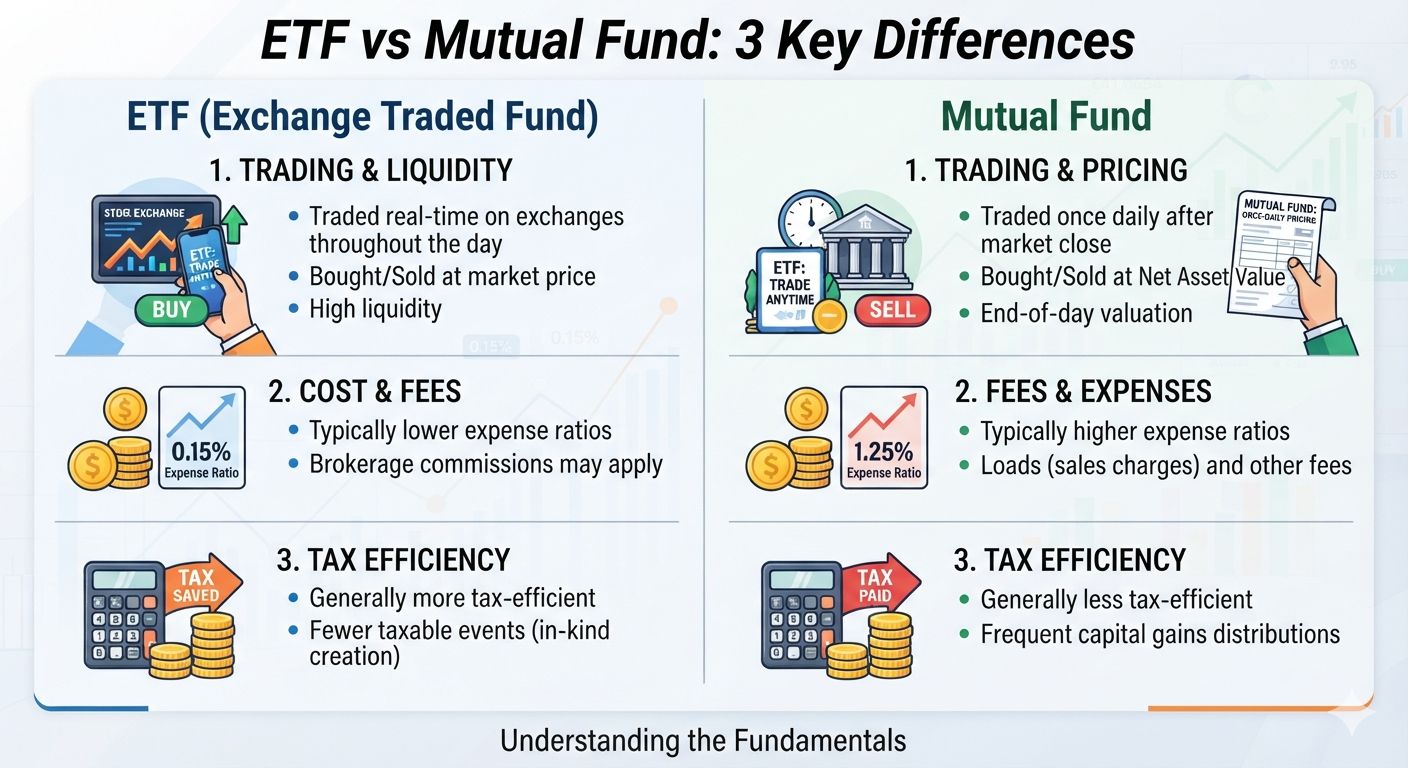
One of the most overlooked aspects of passive investing is the difference in transactional friction. When you invest via an Index Fund, you face zero brokerage fees. However, because ETF trades live on a stock exchange, every buy and sell order incurs multiple regulatory and operational levies.
The 4× Fee Multiplier: Investing in an ETF can cost up to four times more in transaction fees than an Index Fund.
When you purchase an ETF on the exchange, your capital accumulates a basket of systemic fees:
1. Exchange Turnover Fees
2. SEBI Turnover Fees
3. Securities Transaction Tax (STT)
4. Stamp Duty
5. GST on brokerage and regulatory charges
Why This Matters While a standard mutual fund transaction might incur a minor fraction of a rupee for a given investment, the same capital routed through an ETF accumulates higher baseline friction. When cumulative transaction charges are factored into personal returns, the minor long-term outperformance of an ETF on a chart can quickly disappear. |
03Total Expense Ratios (TER): Myth vs. Reality
A common argument used by ETF proponents is the lower Total Expense Ratio (TER). A Nifty 50 ETF might feature an expense ratio of just 0.04%, while the corresponding Index Fund charges 0.07%.
0.04% Nifty 50 ETF TER | 0.07% Index Fund TER | 0.03% Difference (TER) |
Crucial Fact — Already Priced InHistorical returns displayed by fund houses are already net of the Total Expense Ratio. The returns you see on tracking platforms have already had fund management fees deducted. You do not need to manually subtract the expense ratio from your final wealth. Therefore, the lower TER of an ETF is already factored into its slight long-term performance edge. |
04Market Hours Flexibility vs. Disciplined Automation
The absolute defining factor between these two vehicles isn't just the tracking cost — it's how and when you purchase them.
Index Funds: Built for Algorithmic Discipline
Index Funds operate entirely on an End-of-Day NAV model. Whether you place your order at 9:30 AM or 2:00 PM, your capital is pooled and you receive the exact same price calculated after the market closes at 3:30 PM. This makes Index Funds the perfect tool for automated, hands-off investing.
ETFs: Built for Tactical Optimization
Because ETFs trade live on the exchange, their prices fluctuate second by second. If sudden global macro news breaks mid-day causing a sharp 2% intraday dip at 11:00 AM, an active investor can instantly lock in that bargain price — a window that Index Fund buyers simply do not have.
Choose Index Funds if...
✔ You prefer "set-and-forget" investing
✔ You want fully automated monthly plans
✔ You don't monitor live market hours
✔ You want no demat account management
Choose ETFs if...
✔ You actively monitor market hours
✔ You want to capitalize on intraday dips
✔ You seek tactical price optimization
✔ You're comfortable with a demat account
The Bottom Line
The narrative that one choice will magically generate millions more is fundamentally flawed. At the broad index level, their core returns are highly synchronized. Market consistency over a 3-to-5-year horizon matters infinitely more than chasing fractions of a percent.
Pick the vehicle that aligns with your behavioral style, stay disciplined, and let compounding do the heavy lifting.
Disclaimer: This article is intended for general educational purposes only and does not constitute financial, investment, legal, or tax advice. All investments in securities markets are subject to market risks. Please read all related documents carefully before investing and consult a SEBI-registered investment advisor before making financial decisions.

CFA, MBA and former corporate CFO with 18 years of global financial experience across the US, UK and India. Sasikumar writes jargon-free, actionable guides on mutual funds, ETFs and retirement planning for Indian investors.