The Power of Asset Allocation: Why a Balanced Portfolio Beats Chasing High Returns
A balanced mix of equity, debt, and gold tends to deliver smoother, often comparable or better long-term returns than an all-equity portfolio, with meaningfully less volatility and smaller drawdowns. You don't need 15–20 funds — 3 or 4 well-chosen ones across these asset classes, matched to your risk tolerance, usually does the job.
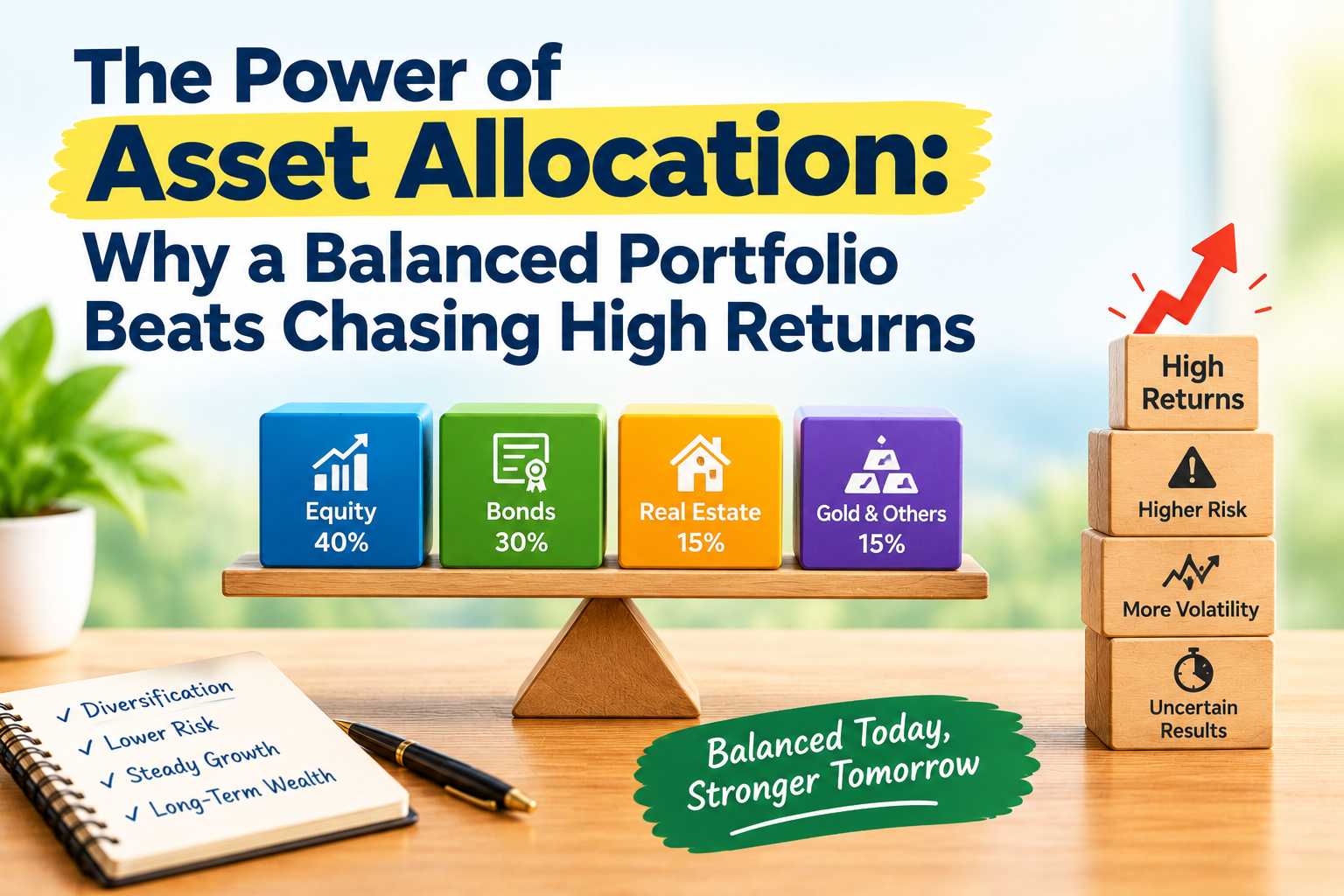
The Power of Asset Allocation: Why a Balanced Portfolio Beats Chasing High Returns
Chasing whichever asset had the best year rarely works — nobody can reliably predict what tops the charts next. A smarter approach is asset allocation: splitting your money across equity, debt, and gold so your portfolio holds up no matter which one has a bad year.
Quick answer, if you're in a hurry: A balanced mix of equity, debt, and gold tends to deliver smoother, often comparable or better long-term returns than an all-equity portfolio, with meaningfully less volatility and smaller drawdowns. You don't need 15–20 funds — 3 or 4 well-chosen ones across these asset classes, matched to your risk tolerance, usually does the job. |
Why Asset Allocation Beats Chasing Returns
Nobody can reliably predict which asset class wins in a given year. The more dependable strategy is to diversify and stay disciplined through rallies and corrections, rather than betting everything on whatever is hot.
A common myth: owning lots of mutual funds automatically means diversification. It doesn't. Real diversification comes from combining assets that don't move together — equity, debt, and gold — so a dip in one is cushioned by steadiness in another.
Understanding Volatility: Why the Ride Matters
Volatility measures how sharply an investment's value swings up and down. Picture a playground swing: a gentle back-and-forth is comfortable for hours, but one pushed violently becomes stressful to hold onto. A volatile portfolio creates that same stress — pushing investors to panic-sell at the worst time.
In finance, this swing is measured as standard deviation — how much returns typically stray from their average. Equities carry high standard deviation, best suited to an 8–15 year horizon so short-term swings have time to even out. Debt instruments have far lower volatility, offering steadier returns. Blend the two, and your portfolio's overall standard deviation drops — a smoother ride that's easier to stay invested through.
What Back tests Show: Comparing Three Portfolio Models
One widely referenced study tested three allocation structures against a pure-equity benchmark over three years. Exact figures vary by period and provider, but the pattern holds:
Portfolio | Mix | Annual Return | Volatility | Max Drawdown |
Benchmark | 100% Equity | ~16.9% | ~14.2% | ~19% |
Equal-Weight | 34% Equity / 33% Debt / 33% Gold | ~19.7% | ~10.4% | ~15% |
Growth-Oriented | 60% Equity / 20% Debt / 20% Gold | ~18.4% | ~11% | ~16% |
Traditional 60/40 | 60% Equity / 40% Debt, no gold | ~15.5% | ~10.8% | ~14% |

Illustrative back test: both multi-asset mixes beat the pure-equity benchmark on returns while cutting volatility and drawdown meaningfully.
The pattern: adding gold alongside equity and debt tends to improve the risk-return trade-off versus a plain 60/40 mix, since gold often moves independently of both.
Why Smaller Drawdowns Matter
A portfolio that falls 15% needs a smaller bounce-back (~18%) to recover than one falling 19% (~23%). Smaller drawdowns mean faster recovery — and more time actually compounding, instead of just getting back to even.
Building a Simpler, Smarter Portfolio
You don't need 15–20 funds. A focused 3–4 funds spanning equity, debt, and gold — matched to your risk tolerance and life stage — usually captures most of the benefit:
1. Growth engine: a diversified equity fund for long-term appreciation.
2. Stability anchor: a debt fund for steady, low-volatility returns.
3. Non-correlated hedge: a gold fund, which often rises when equities fall.
4. Optional fourth slot: a second equity style (value vs growth) to reduce overlap.
A Tax Perk Worth Knowing: Deferral in Debt Funds
Debt mutual funds offer a quiet edge over fixed deposits: you pay tax only when you redeem, not every year automatically. FD interest, by contrast, is taxed annually whether you withdraw it or not. That said, since April 2023, debt fund gains are always taxed at your slab rate on redemption, with no long-term benefit or indexation — deferral helps, but no longer comes with a lower rate.
Frequently Asked Questions
Is a balanced portfolio really better than an all-equity one?
Often, yes — on a risk-adjusted basis. Back tests commonly show multi-asset portfolios with comparable or higher returns and meaningfully lower volatility and drawdowns than pure equity.
How many mutual funds do I actually need for good asset allocation?
Usually just 3–4, spread across equity, debt, and gold. More funds within the same asset class mostly adds overlap, not real diversification.
Why include gold in a portfolio alongside equity and debt?
Gold tends to move independently of equities and debt, so it can hold or gain value when the other two struggle — smoothing out your overall returns.
The Bottom Line
Chasing last year's best-performing asset is a losing game, because nobody can consistently predict what wins next. A balanced mix of equity, debt, and gold — even without constant rebalancing — tends to deliver smoother returns, smaller drawdowns, and faster recoveries than an all-in equity bet. Build your allocation around your own risk tolerance and timeline, not around chasing headlines.
Disclaimer This article is for general information only, not personalized financial or tax advice. Back tested and historical figures don't guarantee future performance, and tax rules change. Consult a certified financial advisor before investing. |