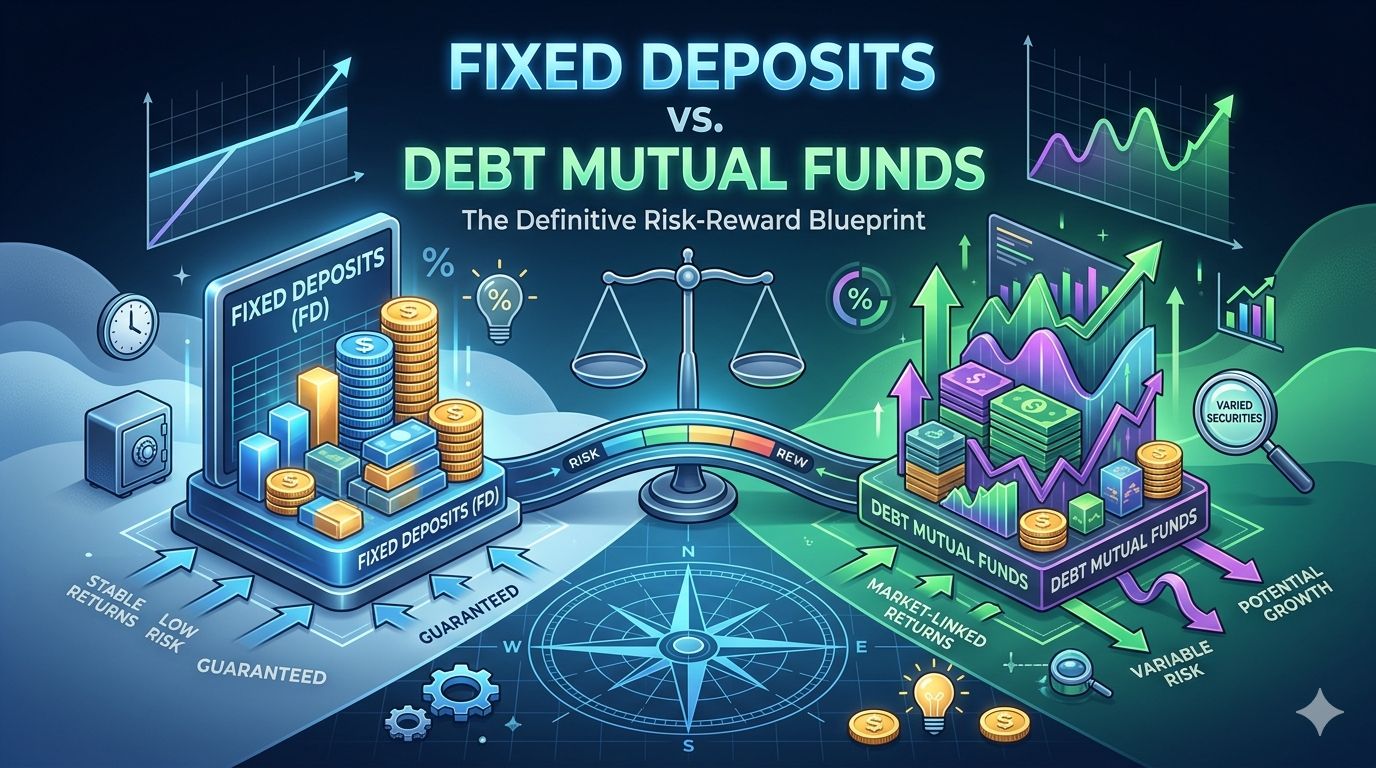
Fixed Deposits vs. Debt Mutual Funds: The Definitive Risk-Reward Blueprint
Compare bank fixed deposits with debt mutual funds and Target Maturity Funds. Understand interest rate cycles, credit risk, and portfolio stability.
Fixed Deposits vs. Debt Mutual Funds: The Definitive Risk-Reward Blueprint
In personal finance, risk and return are two sides of the same coin. For generations, Indian families parked their savings in standard Bank Fixed Deposits (FDs).
Today, the fixed-income market has evolved. Debt mutual funds, corporate bonds, and Target Maturity Funds (TMFs) offer powerful alternatives. To grow your capital, you must understand how these tools work. You need to look at costs, taxes, and risks. These factors separate traditional FDs from modern debt options.
Part 1: The Structural Mechanics of Fixed Deposits (FDs)
Traditional bank fixed deposits are highly popular. This popularity comes from easy access and mental peace. The Reserve Bank of India (RBI) closely monitors commercial banks. Because of this regulation, the risk of a bank failing is extremely low.
Even with great stability, fixed deposits have clear drawbacks:
The Tax Drag (TDS Disadvantage): FD interest is fully taxable. Your tax slab rate determines the final amount you pay. Banks also deduct Tax Deducted at Source (TDS) automatically. This happens once your yearly interest crosses set limits. If you are in a zero-tax bracket, you lose instant cash flow. You must wait for your yearly tax refund to get that money back.
Premature Withdrawal Penalties: FDs lock your money into a tight time-frame. You might choose terms of 1, 3, or 5 years. Taking out cash early lowers your final returns. Banks charge a penalty fee, which cuts your earning rate.
Part 2: Understanding Corporate Bonds and Debt Mutual Funds
A bond is a basic fixed-income tool. Companies or governments issue bonds to raise long-term cash. They offer a set coupon interest rate for a fixed term, like 5 or 10 years.
Individual stocks are highly liquid. You can trade them easily on retail exchanges. In contrast, the secondary bond market in India belongs mostly to institutions. Banks, insurers, and fund houses trade massive blocks of debt with each other.
Retail investors cannot buy individual corporate bonds easily. The secondary market lacks retail liquidity. Therefore, debt mutual funds are the most efficient option.
When you buy a single corporate bond, you take on massive risk. If that single firm fails, your capital vanishes. Debt mutual funds fix this issue. They pool investor cash and spread it across dozens of different government and corporate bonds.
Part 3: Navigating the Three Core Risks in Debt Funds
Debt funds show less price volatility than stock markets. However, they are not risk-free. Any asset that pays a return carries some risk.
Fixed-income options face three main structural threats:
Interest Rate Risk: Rate shifts move in the opposite direction of bond prices. When general interest rates rise, new bonds offer higher payouts. Because of this, old bonds with lower yields drop in price. Their value falls to match current market options.
Credit Risk (Default Risk): Your debt fund holds bonds from various issuers. Credit risk means a firm might fail to pay its scheduled interest. It may even fail to repay the principal amount. Even safe companies can hit sudden business trouble. If a default occurs, the fund manager cuts the value of that asset. This action directly lowers the fund's Net Asset Value (NAV).
Liquidity Risk: In times of severe market fear, the debt market can lock up. This freeze makes it hard for fund managers to sell corporate bonds. They struggle to get cash for heavy investor cashouts. To fix this bottleneck, SEBI built specialized backstops. These Alternative Investment Funds (AIFs) supply emergency cash to debt funds if markets freeze up.
Part 4: Categorization of the Fixed-Income Portfolio
You should match your investment timeline with the right debt tool. Fund houses separate debt mutual funds by their maturity timelines:
Liquid Funds: These funds invest solely in ultra-short money instruments. Their maturity timelines cap out at 91 days. This category has nearly zero interest rate risk. It works perfectly for corporate cash or short-term savings.
Ultra-Short-Duration & Short-Duration Funds: These funds place capital into high-grade institutional bonds. Their maturity targets range from a few months up to 3 years.
Gilt Funds: These vehicles invest only in sovereign bonds from the central or state governments. They remove credit risk completely. However, they suffer high-interest rate swings due to long maturity terms.
Part 5: The Tactical Asset Allocation Framework
You can build a strong, low-stress income plan. It can balance safety, stability, and tax perks. Divide your portfolio into three distinct layers:
Allocation Layer | Ideal Investment Vehicle | Core Objective |
1. Emergency Base | Bank Fixed Deposits & Liquid Funds | Smooth, instant cash access. |
2. Core Operational | Ultra-Short & Short-Duration Bond Funds | Steady yields for a clear 1-to-3-year timeline. |
3. Strategic Investment | Target Maturity Funds (TMFs) | Predictable targets (5 to 12+ years) with great tax setup. |
Strategic Verdict
The National Pension System is a strong foundation. You should maximize your investments there first. Use it to hit your exact corporate tax break caps under Section 80CCD (2). However, your wider financial roadmap needs balance. Combine these locked systems with direct equity holdings and flexible mutual funds. This strategy keeps your liquidity high and gives you full cash-out control.
Disclaimer: This article is for educational purposes only. It does not offer official financial, investment, legal, or tax advice. Please speak with a SEBI-registered investment advisor or certified financial planner before making major asset changes.

CFA, MBA and former corporate CFO with 18 years of global financial experience across the US, UK and India. Sasikumar writes jargon-free, actionable guides on mutual funds, ETFs and retirement planning for Indian investors.