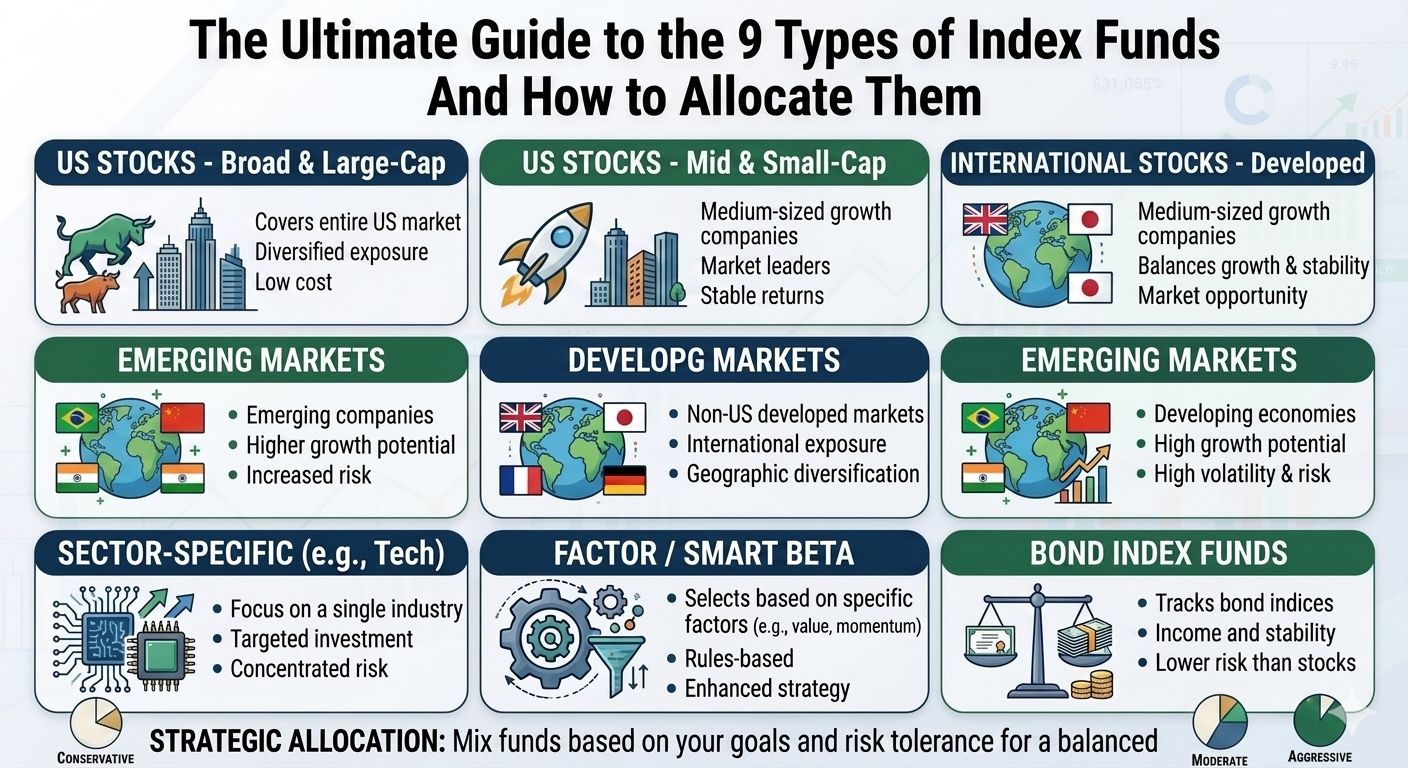
The Ultimate Guide to the 9 Types of Index Funds And How to Allocate Them
Discover the 9 essential types of index funds and learn exactly how to allocate them to build a low-cost, high-return portfolio. Read the ultimate guide.
The Ultimate Guide to the
9 Types of Index Funds
And How to Allocate Them
Passive investing has taken over the financial world. Millions of investors across the globe now turn to passive instruments to build reliable wealth. However, a standard index fund follows a one-size-fits-all model, and it might not match your specific financial goals.
To build a truly strong, diversified portfolio, you need to understand the nine distinct categories of index funds available in the market today. This step-by-step guide breaks down these funds and explains how to use them to invest your money well.
STEP 01 BROAD MARKET INDEX FUNDS
Capture the Entire Market
▶ How It Works
In India, more than 5,000 companies list on the stock exchange, but the top 10% make up over 95% of the total market value. Funds like the Nifty 500 or new "total market" funds (which track up to 750 stocks across large, mid, small, and micro-cap companies) capture the total performance of the economy.
💡 Investment Tip: Expect some overlap if you combine these with other targeted index funds. Don't let it worry you, as long as you stay careful with your broader asset allocation.
STEP 02 MARKET-CAP WEIGHTED INDEX FUNDS
Anchor Your Wealth
▶ How It Works
Large corporations form large-cap benchmarks like the Nifty 50 or Sensex. Medium-sized firms fall into mid-cap indices (like the Midcap 150), while smaller businesses sit at the bottom, in small-cap benchmarks.
💡 The Structural Flaw: Keep in mind that market-cap funds naturally give more weight to overvalued, expensive stocks and less weight to undervalued ones. This can sometimes distort the market and push bull runs to unsustainable levels, before prices fall back to normal and trigger a market-wide correction.
STEP 03 EQUAL WEIGHT INDEX FUNDS
Counteract Valuation Biases
▶ How It Works
If you choose a Nifty 50 Equal Weight Index, the fund gives all 50 companies an identical 2% weight, regardless of their size.
💡 The Performance Edge: Think of this as a perfectly balanced ship that ignores price momentum and valuation biases. While market-cap funds can win over short periods, historical data shows that equal-weight strategies often deliver better returns over very long periods, thanks to their value focus and deep sector diversity.
STEP 04 FACTOR-BASED (SMART BETA) FUNDS
Enhance Performance
▶ How It Works
Algorithms analyse complex data to sort stocks by specific "factors" such as value, momentum, low volatility, or quality (which looks at Return on Equity, cash flows, and low debt levels).
💡 Advanced Strategy: Look for new multi-factor index funds that combine two or three factors to manage returns, risk, and portfolio volatility all at once, in a highly efficient way.
STEP 05 STRATEGIC & MULTI-DIRECTIONAL INDEX FUNDS
Understand Alternative Strategies
▶ How It Works
Institutions use complex strategies such as 2x leverage indices (which double the daily risk and return of an underlying benchmark), arbitrage, futures, inverse indices, and currency hedging.
💡 Market Status: While mainstream retail funds that use features like 2x leverage are common internationally (such as in the United States or South Korea), they remain rare or tightly restricted in the Indian retail market.
STEP 06 SECTORAL & THEMATIC INDEX FUNDS
Generate Focused Growth
▶ How It Works
Instead of trying to time individual stocks, buy into broader sector blocks like Banking, Technology, Healthcare, Infrastructure, or Consumption.
💡 Granular Options: Passive investing now offers highly specific, narrow options. For instance, within banking, you can choose to put your money only into a PSU Bank index fund or a Private Bank index fund.
STEP 07 GLOBAL / INTERNATIONAL INDEX FUNDS
Insulate Capital Internationally
▶ How It Works
Passive cross-border funds let you track major global benchmarks like the US S&P 500, the NASDAQ 100, the NYSE FANG+ index, or developed Asian benchmarks like the Hang Seng index.
💡 The Performance Advantage: Top global indices often show a very low correlation with domestic indices like the Nifty 50. This opposite movement acts as a strong geographic hedge and fills tech gaps in your domestic holdings.
STEP 08 TARGET MATURITY DEBT INDEX FUNDS
Stabilize Risk
▶ How It Works
Traditional debt investments carry interest rate risk and credit default risk. Target maturity funds solve this by copying custom indices that hold AAA-rated corporate bonds, Public Sector Undertaking (PSU) bonds, or State Development Loans (SDLs), all tied to a fixed maturity date.
💡 The Safety Lock: If you buy and hold a target maturity fund until its fixed end date, you cancel out interest rate risk completely, and sovereign and high-grade institutional backing greatly reduces default risk.
STEP 09 CUSTOM INDEXING
Tweak Strategy via Tailored Approaches
▶ How It Works
Advanced data processing lets advisory firms and large financial institutions move away from rigid, pre-built rules. They can write custom passive rules to build portfolios that match specific risk-reward goals.
💡 Future Outlook: Custom indexing is growing fast and is set to become mainstream over the coming years, which makes it a frontier of passive investing worth watching.
Quick Reference: The 9-Tier Passive Universe
# | Category | Primary Methodology | Core Strategic Purpose |
1 | Broad Market | Replicates massive equity expanse (e.g., Nifty 500) | Long-term total economic capture |
2 | Market-Cap Weighted | Weights stocks strictly by company valuation size | Standard core equity benchmark growth |
3 | Equal Weight | Allocates identical percentages to every stock | Eliminates price momentum & size bias |
4 | Factor-Based | Filters by specific traits (Quality, Momentum, Value) | Alpha generation via Smart Beta filters |
5 | Strategic/Leveraged | Employs derivatives, leverage, or short structures | Magnified or inverse multi-directional plays |
6 | Sectoral/Thematic | Concentrates heavily on a single industry vertical | Targeted industry outperformance capture |
7 | Global/International | Tracks cross-border overseas benchmarks | Geographic risk mitigation & currency hedge |
8 | Target Maturity Debt | Passive high-grade bonds with a fixed end date | Fixed-income safety with locked-in yields |
9 | Custom Indexing | Bespoke passive frameworks built by institutions | Personalized, rules-based strategy design |
Disclaimer: This blog post is meant strictly for general educational purposes and does not offer financial, legal, tax, or investment advice. The author is not registered with the Securities and Exchange Board of India (SEBI) or any other regulatory authority as a certified investment advisor. All data, opinions, and analysis here come from personal study and views at the time of writing. Past performance does not guarantee future results. Every investor must do independent research or seek advice from a qualified, certified authority before investing capital.

CFA, MBA and former corporate CFO with 18 years of global financial experience across the US, UK and India. Sasikumar writes jargon-free, actionable guides on mutual funds, ETFs and retirement planning for Indian investors.