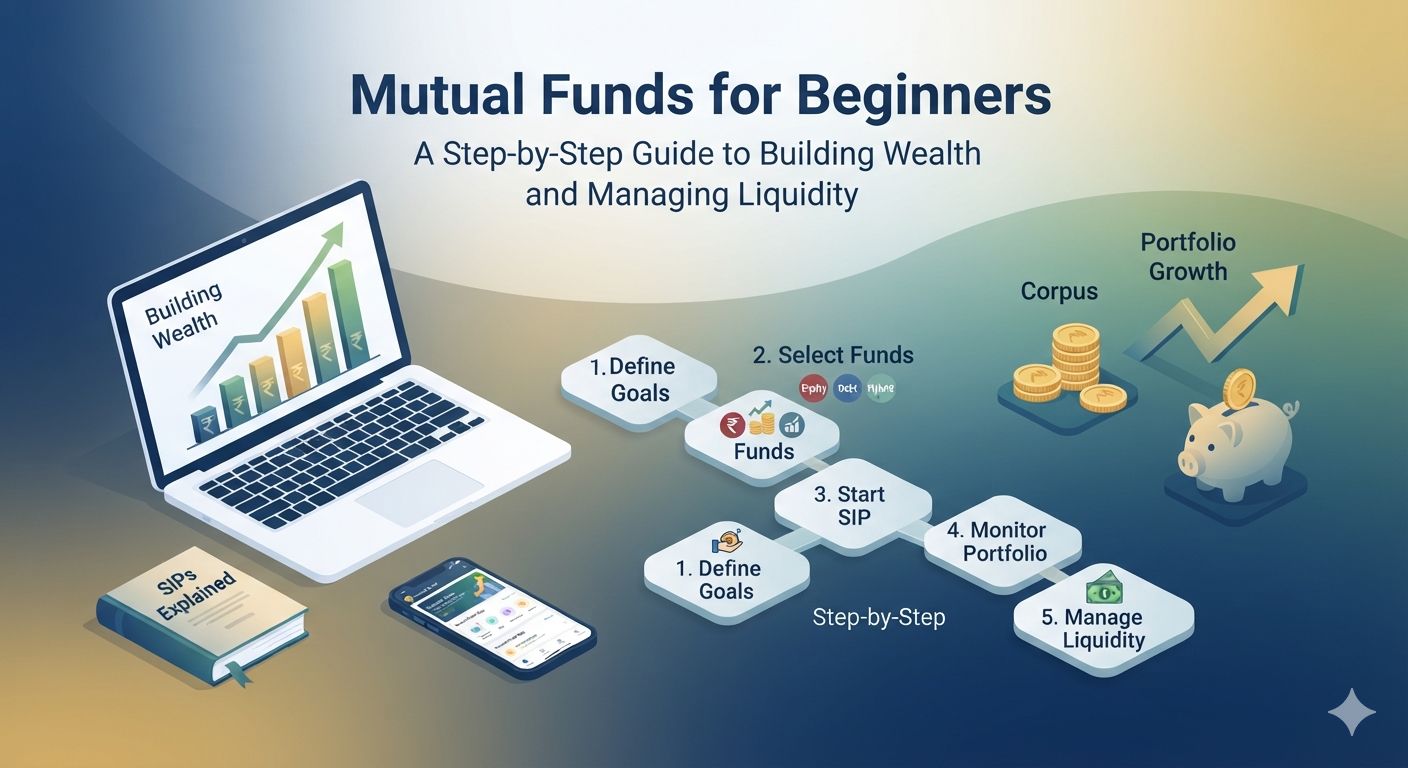
Mutual Funds for Beginners: A Step-by-Step Guide to Building Wealth
This step-by-step guide walks you through what mutual funds are, the main categories to know, how liquid funds work for short-term cash, and the checks to run before you invest a single rupee.
Mutual Funds for Beginners
A complete framework for understanding fund categories, leveraging liquid funds, and conducting due diligence.
Investing in the stock market can feel overwhelming due to excess choice, complex financial jargon, and constant market price fluctuations. Reading a comprehensive mutual funds for beginners guide helps simplify this landscape into an accessible, structured path toward long-term financial growth.
This step-by-step guide walks you through what mutual funds are, the main categories to know, how liquid funds work for short-term cash, and the checks to run before you invest a single rupee.
STEP 1 Understand What a Mutual Fund Is
A mutual fund pools money from many individual and institutional investors. That collective capital is placed under the management of a professional Asset Management Company (AMC) and overseen by a dedicated fund manager.
Direct stock investing vs. mutual fund investing
Direct stock investing: Requires you to do your own fundamental analysis, track market cycles, time your entry and exit, and manage portfolio risk yourself.
Mutual fund investing: Outsources stock selection and rebalancing to an experienced fund manager. You just pick a fund that matches your risk tolerance and time horizon — the manager handles the rest.
STEP 2 Learn How a Mutual Fund Actually Works
Once you invest, your money moves through a simple four-part cycle:
1. Capital pooling — Investors contribute money into a unified fund scheme.
2. Asset deployment — The fund manager invests the pooled capital across diversified assets — equities, fixed-income debt, or money market instruments — based on the scheme's stated objectives.
3. Income & capital gains — The portfolio earns money through interest payments, dividends, or capital appreciation (price growth).
4. Expense ratio — The AMC deducts a small annual fee — the Expense Ratio, typically 0.5% to 2.5% of assets under management — to cover operating and management costs. What's left is passed on to unit holders in proportion to their holding.
STEP 3 Pick the Right Category for Your Goal
Regulators classify mutual funds into five broad categories. Match the category to your own risk appetite and time horizon before you look at individual schemes.
Fund Category | Asset Universe | Risk / Horizon |
Equity Funds | Stocks & equities | High risk / long-term growth |
Debt Funds | Bonds, G-Secs, money market | Low to moderate / capital preservation |
Hybrid Funds | Blend of equity & fixed income | Balanced risk / medium-term growth |
Solution-Oriented Funds | Goal-specific allocation (children, pension) | Lock-in / target-goal focused |
Benchmark indices (Nifty 50, Sensex) | Market-linked / passive tracking |
Equity Mutual Funds: Invest mostly in public company shares. Aim for long-term capital appreciation but carry higher short-term volatility. Best suited to a 5+ year horizon.
Debt Mutual Funds: Allocate capital to fixed-income securities — government bonds, corporate debentures, treasury bills. Because these don't ride stock-market swings, debt funds are more stable and less volatile than equities.
Hybrid Funds: Combine equities and debt in a single portfolio, balancing growth potential with income stability to cushion downside during market drawdowns.
Solution-Oriented Funds: Built around specific life goals such as retirement or a child's education, usually with a minimum lock-in (e.g., 5 years) to enforce investment discipline.
Index & Passive Funds: Passively track a benchmark index like the Nifty 50 or BSE Sensex instead of trying to beat the market, and typically charge a much lower expense ratio.
STEP 4 Consider Liquid Funds for Short-Term Cash
If you're a freelancer, business owner, or salaried professional sitting on idle cash, a traditional savings account often pays too little to keep up with inflation. Liquid mutual funds are a common alternative for parking money short-term.
91-day maturity cap: Liquid funds are restricted by regulation to debt and money market instruments with a residual maturity of up to 91 days.
High liquidity: No lock-in period. Redemption are typically processed within 1–2 business days, which makes liquid funds useful for emergency reserves or temporary business surpluses.
Higher yield potential: Liquid funds aim to outperform standard savings account rates while keeping volatility low.
STEP 5 Know the Risks Before You Rely on Liquid Funds
Liquid funds carry far less risk than equity or long-term debt schemes, but they aren't risk-free.
The commercial paper (CP) vulnerability
Liquid funds often hold Commercial Papers (CPs) — short-term corporate debt instruments. Unlike government-backed Treasury Bills, CPs are unsecured corporate IOUs.
If the issuing company runs into solvency trouble or defaults (as happened in high-profile cases like IL&FS), the Net Asset Value (NAV) of any liquid fund holding those papers will drop.
STEP 6 Run This Checklist Before You Invest
Step 6.1 — Check entry and exit loads: Check whether the scheme charges an Exit Load for early resumptions. Many liquid funds apply a small exit load if you redeem within 7 days of purchase, tapering to 0% after that.
Step 6.2 — Inspect lock-in requirements: Confirm the scheme has no lock-in, unless you're deliberately choosing a goal-based or tax-saving ELSS fund.
Step 6.3 — Analyze portfolio diversification: Review the scheme's underlying holdings on a research platform such as Moneycontrol or Value Research. Make sure capital is spread across multiple issuers rather than concentrated in a few risky corporate papers.
Step 6.4 — Evaluate credit quality: Favor debt and liquid schemes with top-tier credit ratings (A1+ for short-term papers, AAA for long-term bonds) or high allocations to sovereign government securities.
Putting It All Together
Start with Step 1 to understand the basic mechanics, use Step 3 to match a fund category to your goals, and lean on liquid funds (Steps 4–5) only for money you may need at short notice. Whatever you choose, run the Step 6 checklist before committing capital.
Disclaimer
This article is provided strictly for educational and informational purposes only and does not constitute financial, legal, or investment advice. Return metrics, tax rules, and scheme features represent general industry standards and may change over time. Market investments are subject to market risks; review all scheme offering documents carefully before investing. Consult a certified financial advisor prior to making financial decisions.

CFA, MBA and former corporate CFO with 18 years of global financial experience across the US, UK and India. Sasikumar writes jargon-free, actionable guides on mutual funds, ETFs and retirement planning for Indian investors.