The Three-Bucket Retirement Strategy: Balancing Safety, Regular Income, and Long-Term Growth
In retirement, the primary objective is no longer just maximizing absolute returns; it is ensuring a sustainable, inflation-adjusted income stream while eliminating the catastrophic risk of outliving your wealth.
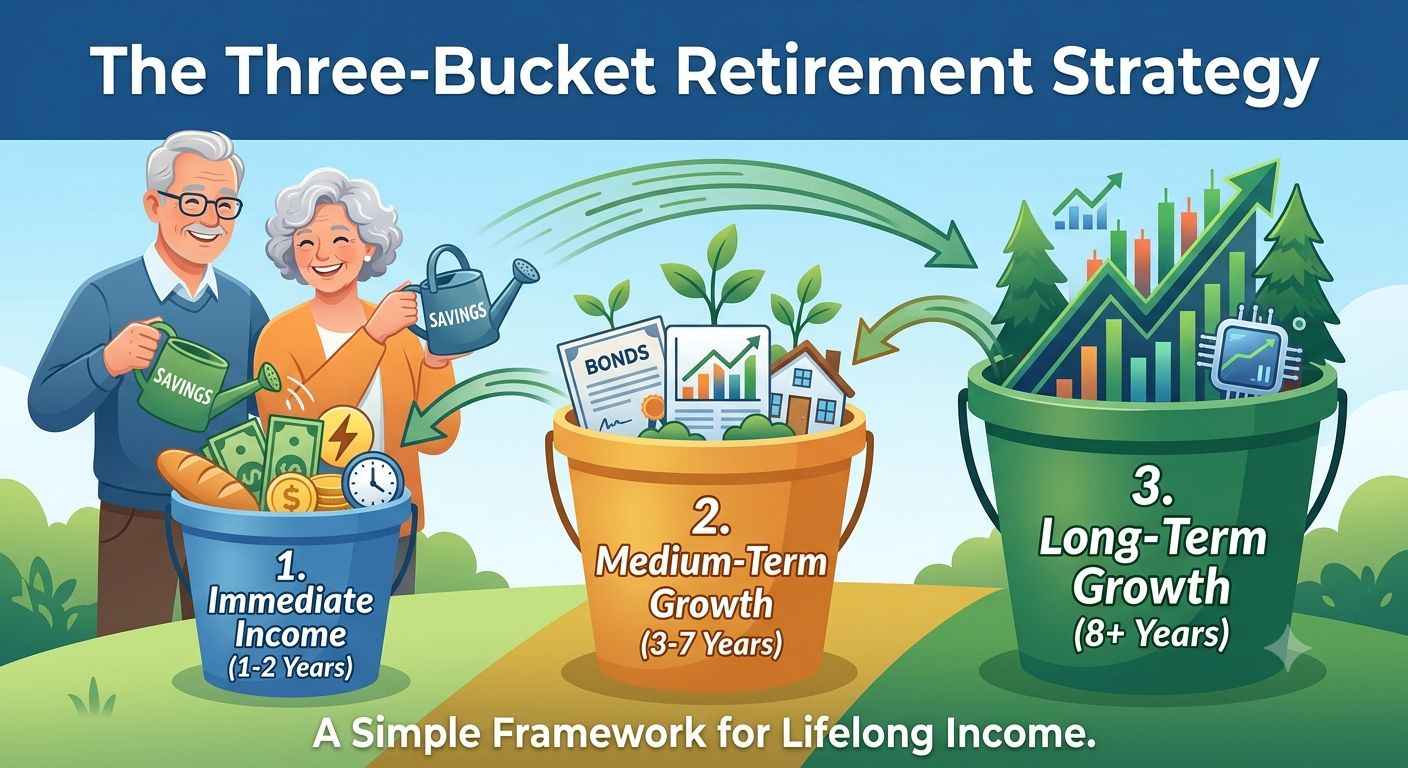
The Three-Bucket Retirement Strategy: Balancing Safety, Regular Income, and Long-Term Growth
Transitioning from asset accumulation to capital consumption is one of the most psychologically and structurally challenging shifts an investor will face. In retirement, the p rimary objective is no longer just maximizing absolute returns; it is ensuring a sustainable, inflation-adjusted income stream while eliminating the catastrophic risk of outliving your wealth.
To achieve this without falling into the trap of over-conservative positioning, sophisticated wealth managers rely on a structured asset allocation framework: The Three-Bucket Retirement Strategy. By segmenting capital into clear operational timelines based on urgency, this framework helps retirees manage near-term liquidity requirements while continuing to participate in long-term equity compounding.
Deconstructing the Three-Bucket Framework
The three-bucket strategy segregates a retirement corpus into separate pools, each designed for a specific time horizon, liquidity requirement, and risk tolerance profile:
Operational Capital Segment | Target Timeline, Instrument Pool & Core Mechanism |
Bucket 1: Immediate-Term Liquidity Pool | Houses cash needed over the next 0 to 18 months for baseline living expenses and emergencies. Strictly deployed in zero-volatility assets like liquid funds, high-yield accounts, or cash to shield principal from market drops. |
Bucket 2: Medium-Term Income Guard | Captures money needed over months 18 to 36. Deployed in short-term debt funds or conservative hybrid vehicles, providing incremental yield optimization while remaining completely insulated from interest rate cycles. |
Bucket 3: Long-Term Compound Growth Engine | Holds remaining surplus capital intended for horizons of 3 to 5+ years. Invested in aggressive hybrid structures or diversified equity mutual funds to capture long-term compounding and defeat inflation. |
Contextual Customization of Asset Allocations
There is no one-size-fits-all formula for sizing these buckets; allocation is entirely dependent on an individual's specific background, baseline support systems, and health profile:
The Impact of Institutional Entitlements: If a retiree is a government employee with guaranteed medical coverage or access to structural health schemes, their requirement for a large, liquid emergency cash pool drops dramatically.
Guaranteed Fixed-Income Backstops: Retirees who possess sovereign-backed, guaranteed fixed-income streams—such as the Senior Citizens Savings Scheme (SCSS) or Post Office Monthly Income Plans (MIP)—can treat those allocations as an independent layer of safety, allowing them to manage their remaining mutual fund buckets with greater agility.
Family Support Frameworks: Living within a multi-generational household where children are financially independent completely alters a retiree's risk landscape, granting them the flexibility to allocate a larger portion of their wealth toward long-term equity compounding.
Mitigating Sequence of Returns Risk and Capital Consumption
The greatest danger a retiree faces in the initial years of capital drawdown is Sequence of Returns Risk—the risk of experiencing a severe market downturn precisely when beginning systematic withdrawals.
If an investor implements an aggressive 8% static withdrawal rate from an equity-heavy portfolio during a market correction, the combination of a 5% market drop and an 8% cash extraction causes the underlying principal to contract rapidly to 94% or 95% of its original value. Once capital is depleted during a downturn, rebuilding a financial cushion becomes mathematically impossible, severely increasing the probability of outliving your savings.
• Adopt a 5% to 6% Baseline Rule: Limit initial withdrawals to a conservative 5% to 6% of the aggregate portfolio value to allow the underlying asset engine to build a durable financial cushion. • Implement a Flexible 'Half-Gain' Policy: If your growth-oriented components achieve a 12% return in a bull market, extract 6% for lifestyle enhancements and reinvest the remaining 6% to build a buffer. If the market flats out or drops, scale down withdrawals to protect core capital. • Target a Long-Term 4% Equilibrium: Once a durable capital buffer has been established over the first three to four years of retirement, smoothly lowering your long-term systematic withdrawal rate to 4% of the total corpus eliminates the risk of portfolio depletion. |
Tax-Efficient Rebalancing through Hybrid Vehicles
Rebalancing a three-bucket portfolio manually by selling appreciating equities to fund debt components creates continuous friction due to transaction costs and Capital Gains Taxes. To minimize these leaks, retirees should design their core rebalancing strategy around automated asset-allocation vehicles, such as aggressive hybrid funds.
By evaluating your aggregate asset allocation through an integrated platform, you can establish structural target boundaries (e.g., a balanced 50-50 equity-to-debt ratio). If an extended bull market pushes equity exposure past your designated threshold (such as 60%), you can execute a single, clean portfolio reset.
Rather than executing frequent, small transactions that trigger short-term tax liabilities, limit your rebalancing to major market moves. Smoothly shift excess gains from your pure equity funds into an aggressive hybrid fund allocation. This approach preserves your necessary liquidity cushions while keeping the underlying equity engine positioned for long-term growth.
Technical Portfolio Q&A: Navigating Regime Shifts in ELSS
The Dilemma: An investor tracking an ongoing Systematic Investment Plan (SIP) over a six-year horizon across two Equity Linked Saving Schemes (ELSS)—one yielding a 21% XIRR and the other a 16.5% XIRR—is transitioning to the modern tax regime, which removes traditional tax deductions on new factor investments. The investor needs to determine whether to stop contributions given the lack of tax incentives.
The Analysis: An ELSS fund functions fundamentally as a diversified, domestic equity mutual fund. The primary structural advantage of an ELSS architecture is its mandatory three-year lock-in period, which provides the fund manager with stable capital and prevents panic redemptions during volatile market cycles. When analyzing the performance variance between a 16.5% return and a 21% return, the difference is often a function of entry timing. If an SIP sequence initiates during a market dip or a lean valuation period, the resulting XIRR will naturally look much stronger than an allocation that began during a market peak.
The Strategic Recommendation:
1. Halt Incremental ELSS Allocations: Because the modern tax framework does not provide a structural deduction for ELSS investments, there is no operational reason to lock up your capital for three years. Direct all future systematic investments into unconstrained, open-ended diversified equity funds or flexi-cap funds to maximize your liquidity.
2. Maintain the Existing Asset Base: Do not withdraw your accumulated capital from these funds simply because the tax deductions have shifted. Selling these assets prematurely will trigger capital gains taxes, reducing your compounding momentum. Let the existing principal continue to grow undisturbed within the equity markets

CFA, MBA and former corporate CFO with 18 years of global financial experience across the US, UK and India. Sasikumar writes jargon-free, actionable guides on mutual funds, ETFs and retirement planning for Indian investors.