5 Strategic Fundamentals of Retirement Planning
You may have saved for retirement. If you dont know how to manage the corpus saved, it may become bigger problem than not saving anything for retirement !! Here are 5 fundamental aspects which you should consider.
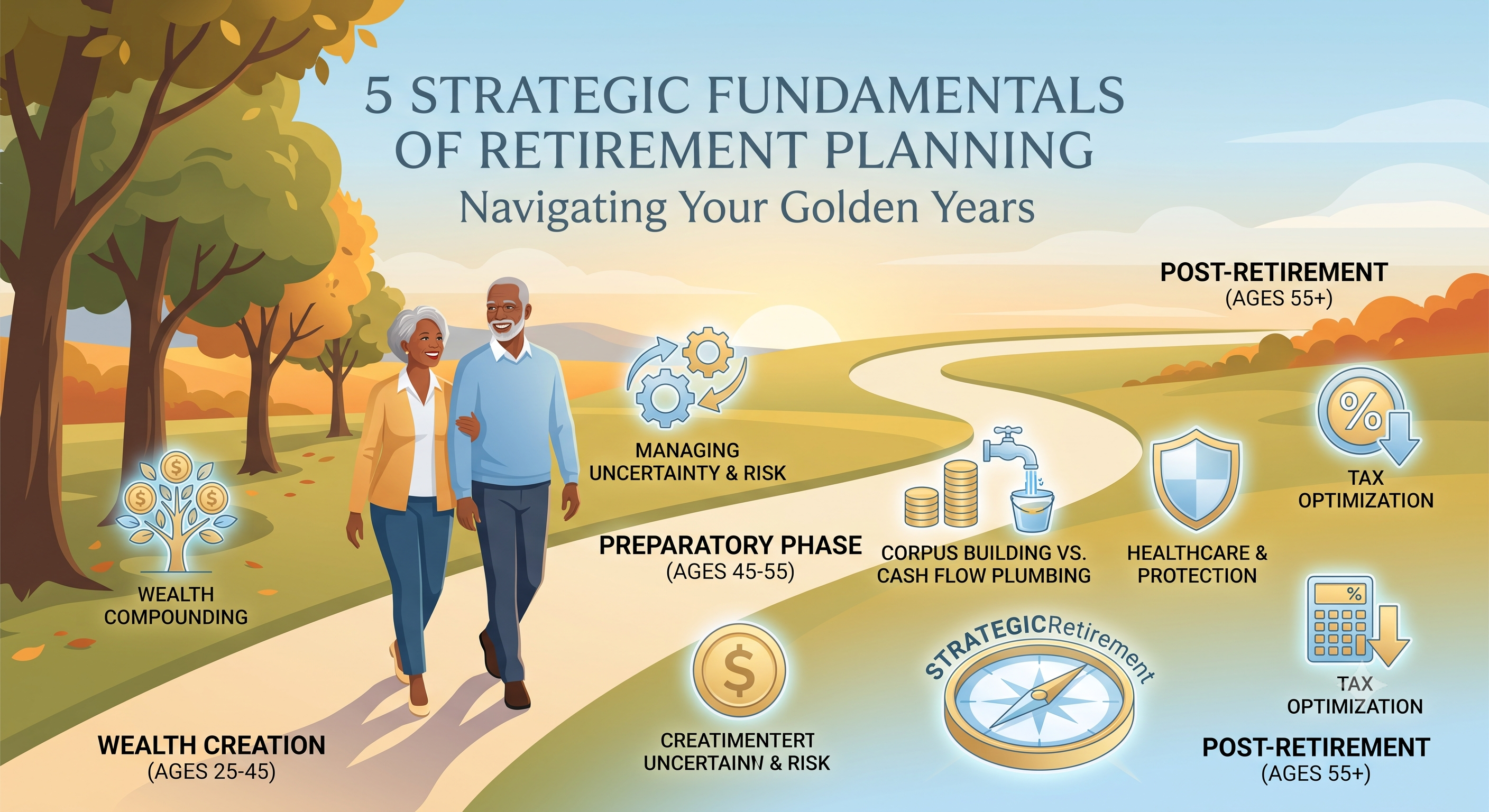
Navigating Your Golden Years: 5 Strategic Fundamentals of Retirement Planning
Building a resilient, successful strategy with modern retirement portfolio management
Retirement planning is often misunderstood as a simple math problem—accumulating a specific sum of money to sustain your current lifestyle once you stop working. However, actual retirement is far more nuanced, dynamic, and fraught with variables that spreadsheets cannot fully predict. Whether you are a professional in your twenties, mid-career in your forties, or standing on the precipice of retirement, understanding the underlying foundational truths is critical.
Failing to grasp these core principles early on can lead to structural flaws in your financial strategy. Here are the five fundamental insights required to build a resilient, successful retirement plan.
1. The Disconnect Between Perception and Reality
Every individual visualizes retirement through the lens of their current life stage. A 25-year-old imagines a completely different post-career life than a 45-year-old or a 55-year-old. The reality is that your priorities, health, financial environment, and structural desires will shift dramatically over time.
Retirement is not just about sustaining a lifestyle or hitting a net worth milestone. It encompasses systemic changes in your day-to-day existence, relationships, and the broader macroeconomic climate. When planning, you must build flexibility into your models to accommodate shifting personal desires and an evolving global landscape.
2. Managing the Vast Uncertainties of Retirement
The hardest truth of financial planning is that no one has personal, firsthand experience with retirement until they are deep within it. True insight belongs to those who have lived through decades of post-career realities, or the specialized wealth managers who guide thousands of families through this exact transition.
Retirement is fundamentally an exercise in managing complete unknowns. Key variables that remain highly unpredictable include:
Longevity Risk: Uncertain life expectancies for both you and your spouse.
Macroeconomic Fluctuations: Changing inflation trajectories and volatile interest rate cycles.
Health and Relational Changes: Unforeseen medical developments and changing dynamics with children or dependents.
Assuming your retirement will follow a perfectly predictable script can lead to catastrophic financial outcomes. Relying purely on a do-it-yourself (DIY) methodology poses significant risks; seeking a professional, experienced perspective is often essential to stress-test your assumptions against these variables.
3. The Three Distinct Phases of the Retirement Journey
A successful retirement strategy requires executing the right playbook at the right time. Mixing up these phases can severely compromise your long-term financial security.
Phase 1: The Wealth Creation Phase (Ages 25–45)
During your early to mid-earning years, your primary goal is aggressive wealth compounding. Because you possess a stable salary to cover daily operations, this capital should be siloed in a dedicated retirement bucket and invested in growth-oriented asset classes.
Equities: Broad market exposure via mutual funds, index funds, or direct equity structures.
Real Estate: High-value tangible assets, provided you possess the liquidity and capability to manage them effectively.
During this phase, avoid the common mistake of over-allocating to low-yield fixed deposits or conservative capital-preservation vehicles.
Phase 2: The Preparatory Phase (Ages 45–55)
Much like an aircraft preparing for descent, this phase requires a fundamental shift in strategy. You must continue building your corpus while simultaneously shifting focus toward structural readiness.
Resource Evaluation: Audit your net worth against remaining life responsibilities (e.g., funding children’s higher education or settling primary mortgages).
Cash Flow Architecture: Start designing the mechanism that will replace your monthly salary. The comfort of retirement is derived from predictable cash flow, not just paper net worth.
Phase 3: The Post-Retirement Phase (Ages 55+)
Once you officially stop working, you enter a multi-decade phase with zero active salary. The primary challenge shifts to managing your capital so that it outlives you.
Many retirees mismanage the large lump sums received at retirement due to a lack of experience in handling concentrated tranches of wealth. Even during retirement, a portion of your capital must continue to grow to outpace inflation, meaning complete capital stagnation in ultra-conservative vehicles can be highly detrimental.
4. Distinguishing Between Corpus Building and Cash Flow Architecture
Building a retirement corpus and structuring a retirement cash flow are two entirely separate disciplines. Young investors must focus on building the size of the bucket; retirees must focus entirely on the plumbing that extracts money from that bucket safely.
Fixed Income & Clean Bonds Annuities & Rentals Growth Equity Compartment Capital Safety Guaranteed Flow Inflation-Hedge
When you transition into the cash-flow phase, capital preservation takes precedence over raw return metrics. You face distinct operational headwinds that must be addressed:
Reinvestment Risk: Fixed deposit or bond yields may drop significantly over a 20-year horizon, diminishing your purchasing power.
Inflation Erosion: Living costs will rise steadily, requiring a rising income stream rather than a static one.
Spousal Protection: Financial structures must be clean and easily navigable so a surviving spouse can manage them seamlessly without exploitation risk.
Healthcare Defenses: A single major medical crisis can decimate an under-insured retirement portfolio. Robust health insurance is a non-negotiable line of defense.
5. Strategic Tax Optimization
Tax mitigation is one of the most reliable ways to instantly boost your real net returns. Every financial vehicle you select should be evaluated based on its net-of-tax yield at maturity rather than its gross headline numbers.
Failing to optimize your portfolio for long-term taxation can lead to severe penalties when it comes time to liquidate your holdings. For instance, an unoptimized multi-million dollar corpus can trigger massive, unnecessary tax liabilities upon withdrawal. Mitigating, postponing, or legally eliminating these tax burdens through strategic product placement during your earning years ensures that your wealth stays entirely in your hands.