ETF vs Mutual Fund: Which Is the Better Investment for You?
Both ETFs (Exchange Traded Funds) and mutual funds are popular investment vehicles in India — but they work very differently !!
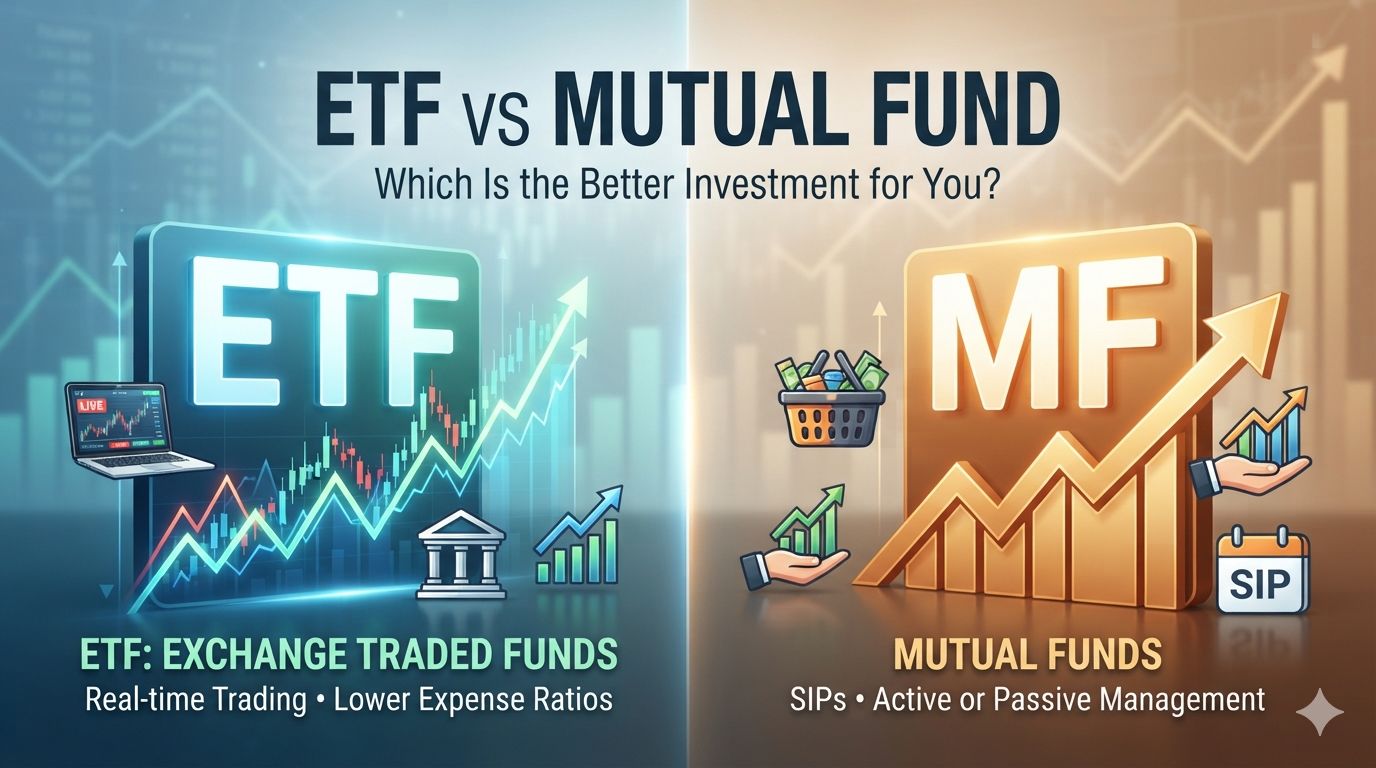
ETF vs Mutual Fund: Which Is the Better Investment for You?
Both ETFs (Exchange Traded Funds) and mutual funds are popular investment vehicles in India — but they work very differently, suit different types of investors, and carry different costs. Understanding the distinction before investing can save you money, reduce confusion, and help you build wealth more efficiently.
What Is an ETF — And How Is It Different from a Mutual Fund?
An ETF (Exchange Traded Fund) is a type of mutual fund, but with one fundamental difference: the way it is bought and sold.
How Mutual Funds Work
• You decide a day to invest and transfer money before the cut-off time of 2:30 PM.
• The fund company processes your investment based on the NAV (Net Asset Value) calculated at end of day.
• You receive units by dividing your investment amount by that evening’s NAV.
• No demat account required. No brokerage fees. No real-time pricing.
How ETFs Work
• ETFs trade live on the stock exchange, just like shares.
• The price fluctuates throughout the day based on demand, supply, and the underlying asset’s value.
• You need a demat account and a brokerage account to buy or sell.
• You can buy in the morning and sell by evening — or hold for years.
What ETFs Are Always Based On
Unlike mutual funds — which can be actively managed or index-based — ETFs are always tied to an index or a commodity:
• Nifty ETF — tracks the 50 stocks in the Nifty index.
• Sensex ETF — tracks the 30 Sensex stocks.
• Gold ETF — tracks the price of physical gold.
• There are no actively managed ETFs in the traditional sense.
The Core Difference: Active vs Passive Investing
Mutual funds offer the full spectrum — from actively managed funds where a fund manager makes investment decisions, to passive index funds.
ETFs are always passive. They simply mirror an index or commodity, with no fund manager making active calls. This structural difference is what drives the cost gap between the two.
Cost Comparison: ETFs vs Mutual Funds
Fees matter enormously over long investment horizons. Here is how the two compare:
ETF Costs
• Expense ratio: Typically 0.05% to 0.75% — significantly lower than most mutual funds.
• Brokerage: Charged every time you buy or sell.
• STT (Securities Transaction Tax): Applicable on every trade.
• Exchange transaction fees: Charged by the stock exchange on every transaction.
Key point: ETFs have a lower underlying expense but add transaction costs every time you trade. Always calculate the total cost — not just the expense ratio.
Mutual Fund Costs
• Regular plan expense ratio: Approximately 1% per year (includes distributor commission).
• Direct plan expense ratio: Approximately 0.5% — half the cost of regular plans.
• No brokerage. No STT on purchase. No transaction fees.
• Entry load: Abolished. You pay nothing extra to invest.
Which Is Cheaper?
For a buy-and-hold investor doing SIP, a direct plan index mutual fund is often cheaper than an ETF once brokerage and transaction costs are factored in. For large, infrequent lump-sum investments, ETFs can offer a cost advantage.
The NAV vs Market Price Problem in ETFs
This is the most critical risk that new ETF investors overlook.
When you buy a mutual fund, you always get units at the official NAV — no premium, no discount. When you buy an ETF, the market price can trade above or below the actual NAV depending on buyer and seller activity.
• If the Sensex is valued at ₹100 but the ETF trades at ₹101, you are paying a 1% premium — an immediate hidden loss.
• The official NAV is only published at end of day. During market hours, only an indicative iNAV is available on the fund company’s website.
• Always check the iNAV before placing any ETF buy order.
The golden rule: Never buy an ETF at a price significantly higher than its NAV.
Advantages and Disadvantages: Side by Side
✅ ETF Advantages
• Lower expense ratios than actively managed mutual funds.
• Real-time trading — buy and sell at live market prices throughout the day.
• Access to unique instruments — some commodities and international indices are only accessible via ETF.
• Full transparency — portfolio holdings are disclosed daily.
❌ ETF Disadvantages
• Requires a demat account and brokerage account.
• SIP automation is complicated — you must manually monitor price vs NAV for every purchase.
• Brokerage, STT, and exchange fees add to total cost on every transaction.
• Liquidity risk — low-volume ETFs can have wide bid-ask spreads.
• NAV premium risk — easy to overpay if you are not monitoring prices carefully.
✅ Mutual Fund Advantages
• Extremely simple to invest — SIP runs automatically with zero manual monitoring.
• No demat account required.
• No brokerage or transaction costs.
• Wide variety — index funds, active funds, debt funds, hybrid funds, ELSS and more.
• Direct plans offer low-cost passive investing comparable to ETFs.
❌ Mutual Fund Disadvantages
• No intraday trading — you cannot react to market movements within the same day.
• Actively managed funds carry higher expense ratios of 1–2%.
• No end-of-day pricing control — you invest at whatever NAV is set that evening.
Who Should Choose ETFs — And Who Should Choose Mutual Funds?
Choose ETFs If You:
• Are an experienced investor comfortable with stock market mechanics.
• Want to trade actively and take advantage of intraday or short-term market movements.
• Are investing a large lump sum and want to minimise long-term expense ratios.
• Want exposure to specific commodities or international indices only available via ETF.
• Already have a demat account and understand how to monitor NAV vs market price.
Choose Mutual Funds If You:
• Are a beginner investor just starting your investment journey.
• Want to run a simple, automated SIP with zero manual effort.
• Prefer to not monitor markets daily or worry about buy/sell prices.
• Want access to actively managed funds with professional stock selection.
• Are investing modest amounts where brokerage costs would erode any ETF cost savings.
The Expert Recommendation for Most Indian Investors
For the vast majority of retail investors in India, mutual funds — particularly direct plan index funds via SIP — remain the better starting point.
The advised approach: begin with a SIP in a good actively managed fund or index mutual fund for at least two to three years. Let your corpus grow and your market knowledge deepen.
Once your investment amount is substantial enough that the expense ratio difference becomes meaningful — and once you are comfortable monitoring NAV premiums and managing a demat account — then consider ETFs as a complementary option.
The bottom line: ETFs are not better than mutual funds. They are simply a different tool, for a different investor, at a different stage of the investment journey.
The One Rule to Remember
Beginners: Start with mutual fund SIPs. Keep it simple, keep it automatic, keep investing. When your wealth grows and your knowledge deepens, ETFs will still be there — and you will be far better equipped to use them correctly.
Disclaimer: This article is intended for general educational purposes only and does not constitute financial, investment, or tax advice. Mutual fund investments are subject to market risks. Please read all scheme-related documents carefully before investing and consult a SEBI-registered investment advisor before making financial decisions.