The Ultimate Guide to Mutual Fund Portfolio Construction and Rebalancing
Many investors fall into common traps—over-diversification, panic selling during market downturns, or ignoring tax implications. This comprehensive guide breaks down how to construct, diversify, and periodically rebalance a mutual fund portfolio tailored to your specific risk tolerance and financial goals.
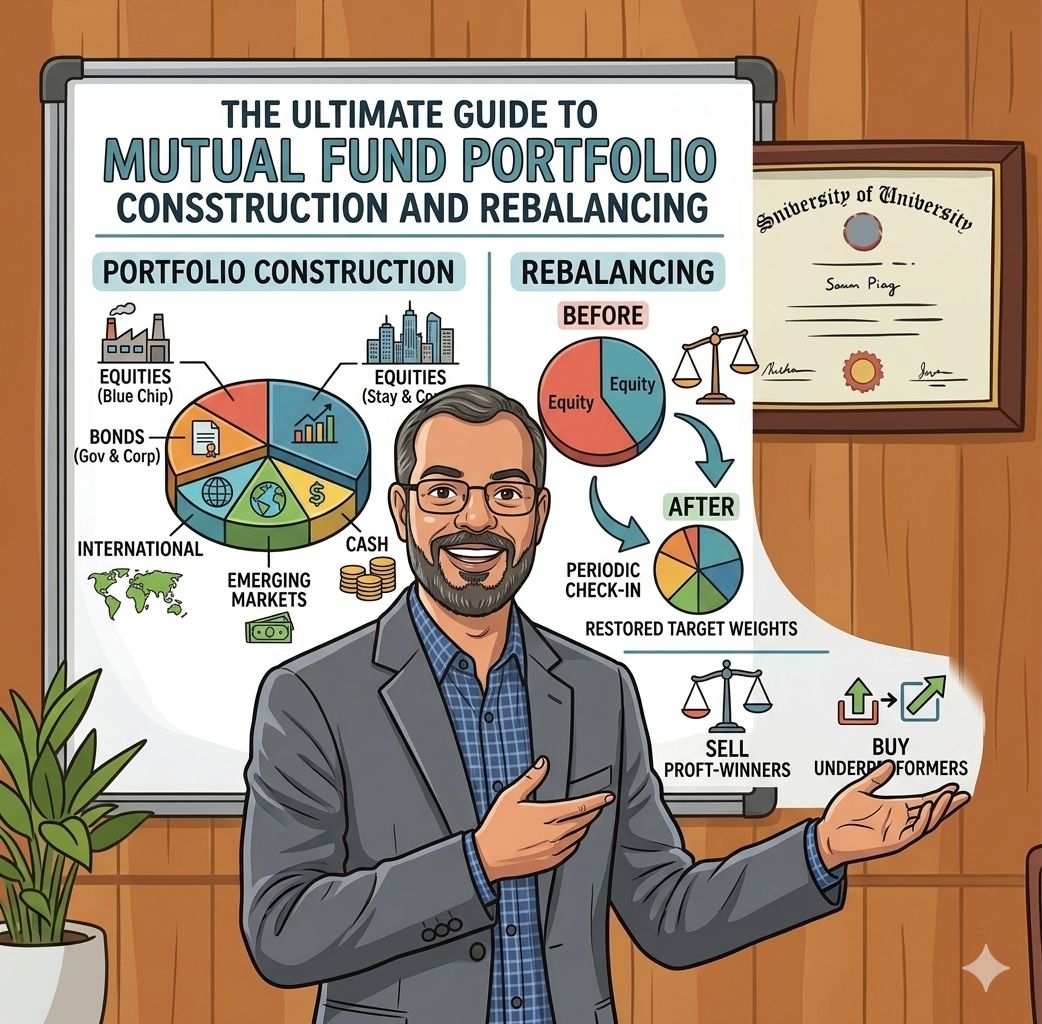
The Ultimate Guide to Mutual Fund Portfolio Construction and Rebalancing
Building a high-performing financial portfolio is rarely about chasing the hottest stock or buying dozens of different funds. True wealth accumulation relies on a disciplined strategy, proper asset allocation, and systematic portfolio management.
Many investors fall into common traps—over-diversification, panic selling during market downturns, or ignoring tax implications. This comprehensive guide breaks down how to construct, diversify, and periodically rebalance a mutual fund portfolio tailored to your specific risk tolerance and financial goals.
What Is Portfolio Rebalancing and Why Does It Matter?
At its core, portfolio rebalancing is the process of realigning the weightings of your asset portfolio. Over time, different asset classes perform at varying rates, causing your target asset allocation to shift.
The Mechanism Behind 'Buying Low and Selling High'
Imagine starting with a portfolio valued at ₹10 lakhs with a strict target allocation:
Equity: ₹9 lakhs (90%)
Gold: ₹1 lakh (10%)
Suppose equity remains flat over a given period while gold surges by 50%. Your total portfolio rises to ₹10.5 lakhs, but your asset split shifts to 86% equity and 14% gold (₹1.5 lakhs in gold). To restore your original 90:10 ratio, you must sell ₹45,000 worth of gold and reallocate those proceeds into equity.
Key Takeaway |
Rebalancing in Theory vs. Practice
While simple in theory, execution presents real-world challenges:
1. Tax Drag: Selling assets in taxable accounts triggers capital gains tax, which can reduce net returns.
2. Behavioral Resistance: Selling an asset class that is currently booming to buy one that is stagnant requires strict emotional discipline.
3. Market Anomalies: A drawdown in equities does not guarantee that gold or debt will rally simultaneously to provide rebalancing liquidity.
Foundations Before Investing: Risk Cover & Emergency Funds
Before deploying capital into equity or gold, every investor must establish a solid financial safety net. Skipping these foundational steps exposes your long-term investments to premature liquidation during personal crises.
1. Risk Protection
Term Insurance: Ensures your financial dependents are completely secure in the event of an unexpected loss of life.
Health Insurance: Covers substantial hospitalization expenses, protecting your investment capital from being drained by medical emergencies.
Separation Rule: Never combine insurance with investment instruments (such as endowment or ULIP plans). Keep them strictly separate.
2. The Emergency Corpus
Maintain at least 6 months of living expenses in highly liquid, capital-preserving instruments. This fund shields your long-term portfolio from forced liquidations during sudden job losses or unexpected home repairs.
The Danger of Over-Diversification
A common mistake among retail investors is accumulating 30 to 50 individual mutual funds under the false assumption that more funds equal lower risk.
Portfolio Overlap and Index Drag
When you hold dozens of funds across Large Cap, Flexi Cap, and Multi Cap categories, you inevitably buy the same underlying stocks multiple times.
Diluted Alpha: High portfolio overlap eliminates your chances of beating the broader market.
Index Returns at Active Costs: Owning too many active funds causes your portfolio to mimic an index fund, yet you continue paying higher expense ratios for active management.
Core Allocation Strategies: Beginner, Intermediate, and Advanced
Asset allocation should reflect your market experience, income stability, and capacity for volatility.
The '100 Minus Age' Baseline Rule
A traditional starting point for equity exposure is 100 minus your age. A 30-year-old would allocate 70% to equity and 30% to debt instruments (including fixed deposits, Provident Fund balances, or Sukanya Samriddhi Yojana). As your total wealth grows, adjust this rule to prevent over-allocating to low-yield debt.
Model Portfolio Structures
Portfolio Level | Target Allocation | Key Mechanics |
Beginner | • 60% Large Cap / Index | Large-cap anchors stability. A low-cost Nifty Index Fund is preferred since 80%+ of active large-cap funds underperform. |
Intermediate | • 60% Flexi Cap Fund | Flexi Cap provides dynamic dynamic market-cap shifts. International exposure guards against country risk and rupee depreciation. |
Advanced (Aggressive) | • 25% Large Cap / Index | High exposure to small and mid-cap sectors generates higher long-term CAGR, balanced by volatility across cycles. |
Tactical Style Diversification: Momentum Factor Investing
In addition to market capitalization, you can diversify across distinct investment styles: Value Investing (buying underpriced assets), Growth Investing (targeting high earning potential), and Momentum Strategy (buying assets with upward price trends).
Incorporating Momentum Factor Indices
Momentum Investing systematically selects stocks exhibiting strong price trends using quantitative indicators like relative volume and the Relative Strength Index (RSI).
To boost aggressive portfolio returns without stock-picking risk, consider replacing a portion of your standard market-cap exposure with rules-based momentum index funds:
Nifty200 Momentum 30 Index: Selects the top 30 momentum performers from the Nifty 200 universe.
Nifty Midcap150 Momentum 50 Index: Filters the top 50 momentum stocks within the mid-cap space.
Implementation Warning |
Matching Portfolios to Specific Financial Goals
Portfolios should serve as targeted financial vehicles designed to achieve specific real-world outcomes. Every complete financial goal requires three variables: Target Corpus, Time Horizon, and Investor Age.
Case Study A: The 10-Year Growth Goal (Young Couple)
Objective: Accumulate ₹1.5 Crores in 10 years for a home purchase.
Strategy: High equity exposure (Large Cap and Mid Cap combination). The 10-year timeline absorbs short-term equity volatility.
Capital Protection Shift: Around Year 8, systematically move accumulated wealth out of equity into ultra-short-term or liquid funds via a Systematic Transfer Plan (STP) to lock in gains.
Case Study B: The 8-Year Capital Preservation Goal (Education)
Objective: Accumulate ₹25 Lakhs in 8 years for higher education expenses.
Strategy: Capital preservation dominates. Pure equity allocation poses too much drawdown risk over an 8-year horizon.
Asset Mix: A conservative balance of Short Duration Debt Funds, Arbitrage Funds, and Corporate Bond Funds, combined with a capped 20% Large Cap Equity allocation.
Step-by-Step Portfolio Maintenance and Rebalancing Rules
1. Establish Review Windows: Rebalance your portfolio on a fixed schedule (every 6 to 12 months) rather than reacting emotionally to daily market swings.
2. Analyze Asset Split & Overlap: Use portfolio tracking tools to import your holdings and inspect your aggregate Large/Mid/Small cap split and XIRR benchmark comparisons.
3. Calculate Capital Gains Tax: Utilize available tax-exempt thresholds (e.g., the annual ₹1.25 lakh LTCG exemption under Indian tax laws) to avoid unneeded tax drag.
4. Execute Cash-Flow Rebalancing: If selling triggers steep taxes, rebalance without selling: redirect ongoing monthly SIP contributions away from inflated assets and into lagging assets.
5. Consolidate Clutter: Stop active SIPs in overlapping or underperforming funds that systematically fail to beat their category average over multiple market cycles.
Summary Checklist for Long-Term Success
1. Cover Base Risks First: Secure comprehensive health and term insurance along with a 6-month emergency fund before allocating capital to equities.
2. Eliminate Portfolio Clutter: Restrict your equity holdings to a focused selection of 3–5 complementary funds to avoid over-diversification.
3. Automate Strategy: Maintain systematic monthly contributions (SIPs) to smooth out market volatility over long investment horizons.
4. Rebalance Systematically: Adjust your asset allocation every 6–12 months to protect profits, control portfolio risk, and maintain your target asset split.
Disclaimer: The content provided in this blog post is intended strictly for general educational purposes and does not constitute financial, legal, tax, or investment advice. The author is not registered with the Securities and Exchange Board of India (SEBI) or any other regulatory authority as a certified investment advisor. All data, opinions, and analysis presented are based on personal studies and perceptions at the time of writing. Past performance is not indicative of future results. Every investor must perform independent due diligence or seek professional advice from a competent certified authority prior to deploying capital.

CFA, MBA and former corporate CFO with 18 years of global financial experience across the US, UK and India. Sasikumar writes jargon-free, actionable guides on mutual funds, ETFs and retirement planning for Indian investors.