Momentum Investing, Explained Simply
A beginner's guide to the Nifty 500 Momentum 50 Index
Momentum Investing, Explained Simply
A beginner's guide to the Nifty 500 Momentum 50 Index
Most index funds pick stocks based on one thing: how big the company is. This sounds safe, but it has a hidden problem. Even if a company stops growing, it can still take up a huge share of your investment — just because it's large. A newer type of index tries to fix this. It's called the Nifty 500 Momentum 50 Index, and instead of picking the biggest companies, it picks the ones rising in price the fastest.
What Is the Nifty 500 Momentum 50 Index?
To understand this index, it helps to know the bigger group of stocks it picks from.
Index | What It Holds | Key Trait |
|---|---|---|
Nifty 50 | Top 50 biggest companies in India | Steady, but can get stuck holding slow-growing giants |
Nifty 500 | All 500 companies — big, medium, and small | A broad mix of the whole market |
Nifty 500 Momentum 50 | Top 50 fastest-rising stocks picked from the Nifty 500 | Refreshed every 6 months to stay with the trend |
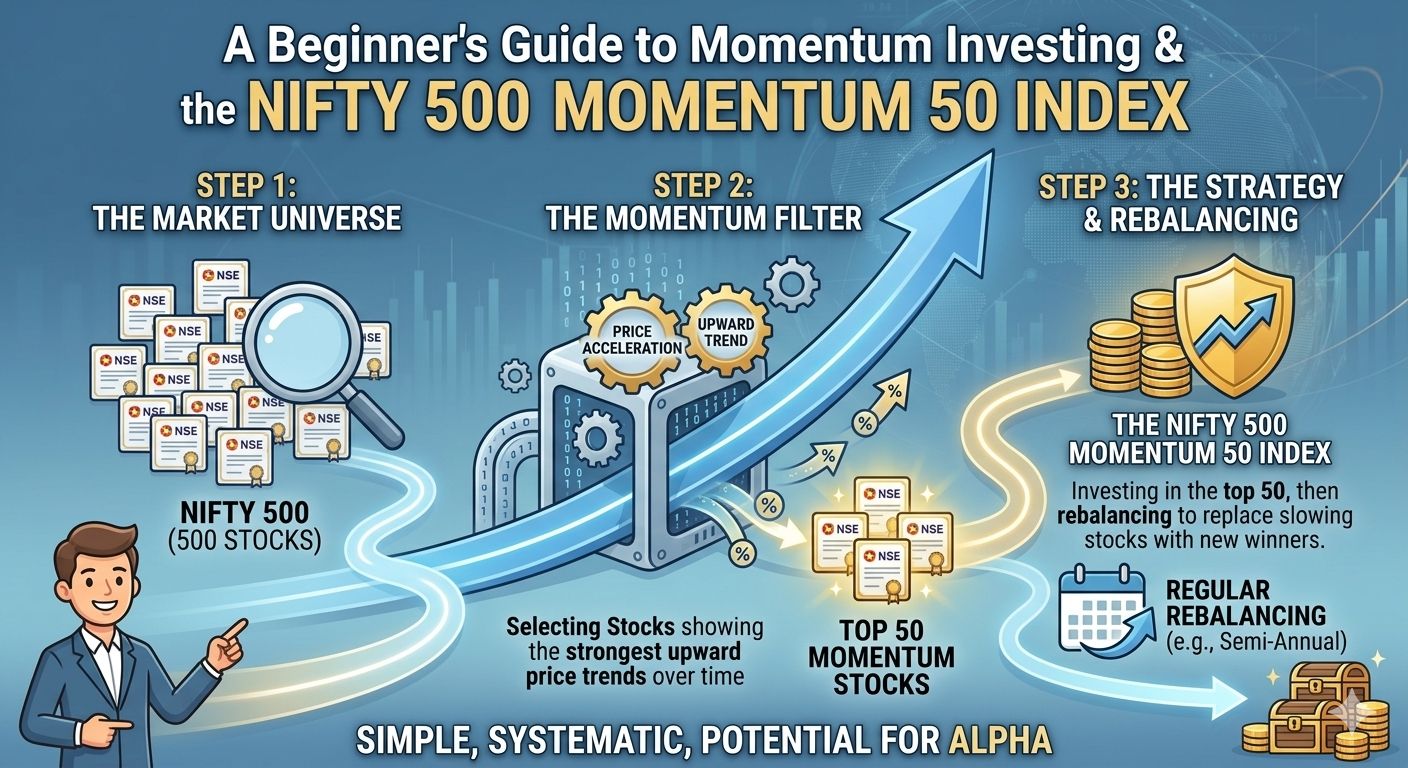
Every six months, the index checks all 500 stocks and picks the 50 that have risen the fastest over the past 6 to 12 months. It then drops the slower stocks and replaces them with new fast-rising ones — automatically, with no manual decisions involved.
The Problem With Old-Style Index Funds
In a regular index fund, a stock's share depends on the company's size — not how well it's doing right now. Because of this, one industry alone (like banking) can take up more than a third of the whole fund. A few large companies can each hold 8% to 12% of your money, individually. This only changes when the company's value actually falls. So if a giant company stops growing, it can weigh down your returns for years without the fund doing anything about it.
How Momentum Investing Fixes This
The Nifty 500 Momentum 50 keeps adjusting itself in two ways:
It moves between industries. When markets get shaky, it can shift up to 40% of the money into safer sectors like healthcare. When other sectors start rising, it shifts the money there instead.
It moves between company sizes. When smaller companies struggle, it shifts money into safer, larger companies (sometimes over 63% of the fund). When smaller companies are rising fast, it shifts money back into them to capture the gains.
How Much More Could You Earn?
Here's a simple example. If you had invested ₹1,00,000 in April 2005 and left it for 20 years:
A regular Nifty 50 fund would grow it to about ₹16,00,000 (about 15.25% growth every year, on average).
The Nifty 500 Momentum 50 would have grown it to about ₹77,00,000 (about 25% growth every year, on average).
The same pattern shows up with monthly investing (a SIP). Investing ₹10,000 every month for 10 years (₹12,00,000 in total) would have grown to about ₹28,65,000 in a regular index fund — versus about ₹50,00,000 in the Nifty 500 Momentum 50.
The Risk You Need to Know
Bigger gains come with bigger swings. In a market fall, a regular index fund might drop by around 5%. A momentum fund can drop by 15% or more in the same period.
Good News for Patient Investors These swings even out over time. Held for 3 years, returns can still occasionally dip. But held for 5 to 7 years, the ups and downs smooth out a lot, and the chance of losing money drops sharply — while the higher growth potential stays intact. |
Tips for Beginners
Think long-term. Stay invested for at least 5 to 10 years, so short-term dips don't scare you into selling early.
Don't put all your money here. Use momentum funds as a smaller, high-growth part of your portfolio — alongside safer, broad-market investments, not instead of them.
Invest a little each month. A monthly SIP helps smooth out the ups and downs, so you're not betting everything on one point in time.
Disclaimer: This article is for general educational purposes only and is not financial, legal, tax, or investment advice. The author is not a SEBI-registered investment advisor. Past performance does not guarantee future results. Please do your own research or consult a certified financial advisor before investing.

CFA, MBA and former corporate CFO with 18 years of global financial experience across the US, UK and India. Sasikumar writes jargon-free, actionable guides on mutual funds, ETFs and retirement planning for Indian investors.