How to Build a Winning Index Fund Portfolio
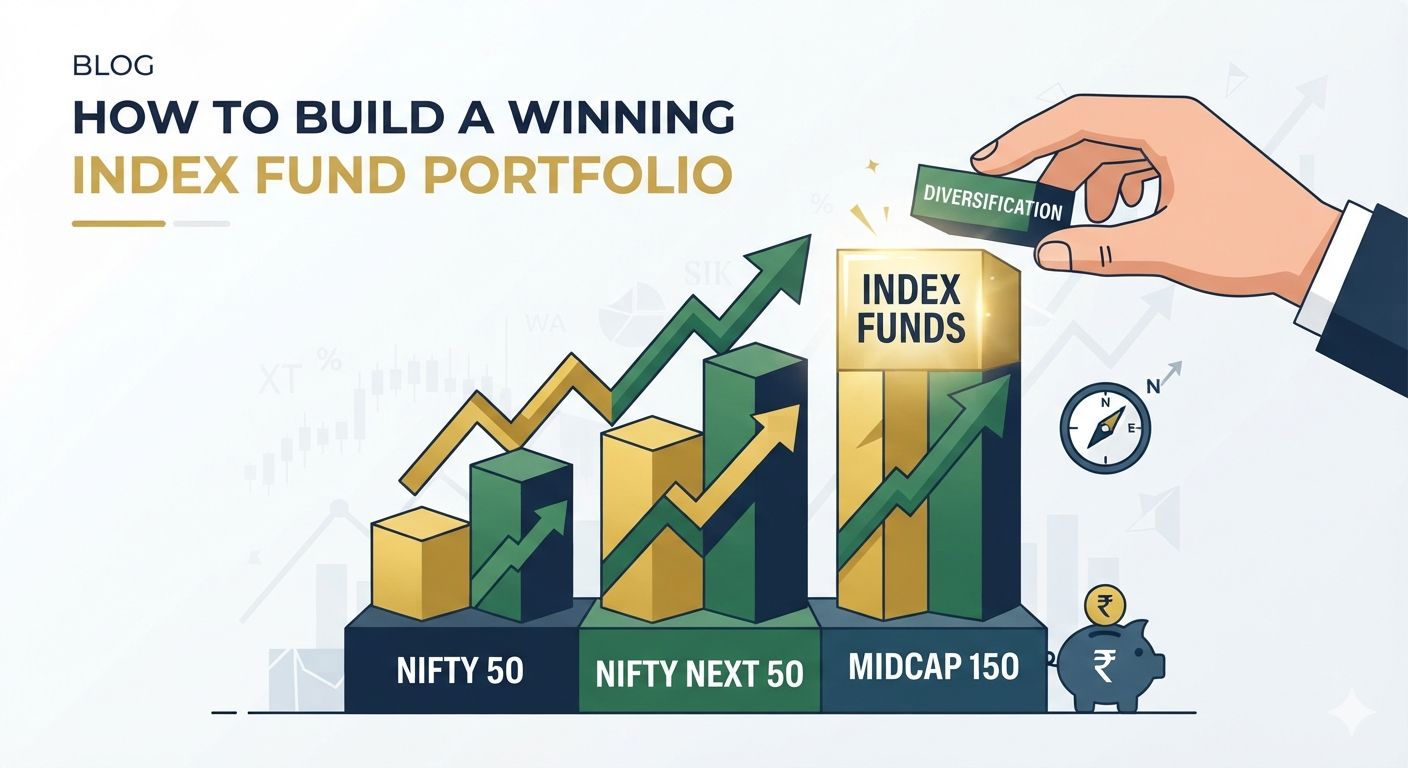
With so many choices available across broad-market, factor-based, sectoral, and international themes, selecting the right options can feel overwhelming. A high-performing passive portfolio requires a strategic combination of diverse indices.
How to Build a Winning Index Fund Portfolio ?
When investors think about index investing, they often limit their choices to basic market-cap benchmarks like the Nifty 50 or the Sensex. However, the Indian index fund market has expanded into a massive ecosystem featuring hundreds of passive schemes.
With so many choices available across broad-market, factor-based, sectoral, and international themes, selecting the right options can feel overwhelming. A high-performing passive portfolio requires a strategic combination of diverse indices.
This guide breaks down the primary categories of equity index funds, analyzes historical performance metrics, and establishes a clear framework to construct a high-performing index portfolio.
1. Broad-Based Market Cap Indices: Building the Core Foundation
Broad-market indices serve as the foundational bedrock of any passive portfolio. They offer systematic exposure across large, mid, and small-sized companies.
Analyzing Long-Term Performance Patterns
When evaluating broad-market historical returns across 3-year, 5-year, 10-year, and 15-year horizons, several key trends emerge:
Returns Hierarchy: Performance generally scales up as you move down the market-cap spectrum. Micro-cap and small-cap indices frequently deliver higher trailing returns, though at the expense of higher short-term volatility.
The Mid-Cap Sweet Spot: Contrary to popular belief, mid-cap indices (such as the Nifty Midcap 150) have historically generated better risk-adjusted long-term returns than pure small-cap indices (like the Nifty Smallcap 250).
Equal Weight Advantage: Equal-weighted variants of large-cap indices (e.g., Nifty 50 Equal Weight) consistently outperform traditional market-cap-weighted counterparts by eliminating mega-cap concentration risk.
The Power of Nifty Next 50: Serving as the gateway to large-cap status (companies ranked 51–100), the Nifty Next 50 acts as a powerful growth driver that is frequently overlooked by retail investors.
2. Factor-Based & Strategy Indices: Unlocking Smart Beta Performance
Strategy or 'smart beta' indices go beyond traditional market capitalization. They use rules-based quantitative filters—such as momentum, value, quality, alpha, and low volatility—to select and weigh stocks.
Factor Indices vs. Traditional Market-Cap Benchmarks
Momentum Factors: The Nifty 200 Momentum 30 and Nifty Midcap 150 Momentum 50 indices have consistently outperformed traditional market-cap indices over multi-year cycles.
Alpha Strategies: Indices like the Nifty Alpha 50 systematically select high-alpha stocks using quantitative measures, delivering strong capital appreciation during bullish market regimes.
Multi-Factor Resilience: Combining single factors (such as Alpha + Low Volatility or Momentum + Quality) smooths out cyclical drawdowns while preserving upside potential.
3. Sectoral and Thematic Indices: Navigating Business Cycles
Sectoral and thematic indices target specific industries, such as banking, auto, technology, real estate, manufacturing, and healthcare.
Understanding Sector Cyclicity
Long Capital Cycles: The Nifty Realty index experienced a multi-year slump between 2012 and 2020 before surging more than 5x post-2020. Despite this recent rally, capital-intensive sectors can remain depressed for extended periods.
Metric-Driven Analysis: Relying purely on historical trailing returns for sector funds can be misleading. Instead, evaluate fundamental drivers such as credit offtake for financial services, capacity expansion for manufacturing, or order book growth for infrastructure.
4. International Indices: Global Diversification
Adding international indices provides geographic diversification, reduces country-specific risk, and offers exposure to global technology trends that may not be well-represented in domestic markets.
Established Tech Leaders: The NASDAQ 100 provides exposure to global technology firms driving advances in artificial intelligence, software, and hardware.
Contrarian Valuation Plays: Emerging tech indices like the Hang Seng Tech Index trade at lower price-to-earnings (P/E) and price-to-sales (P/S) multiples, offering attractive long-term contrarian value opportunities.
The Final Index Fund Portfolio Universe
By combining broad-market anchors, factor strategies, structural macro themes, and international technology exposure, you can construct a balanced index fund portfolio:
Pillar / Category | Selected Draft Funds |
Broad Market Anchors (3 Funds) | • Nifty Next 50 Index |
Factor & Smart Beta (3 Funds) | • Nifty 200 Momentum 30 Index |
Structural Sectoral Themes (3 Funds) | • Nifty Manufacturing Index |
International Technology (2 Funds) | • NASDAQ 100 Index |
Step-by-Step Framework for Portfolio Execution
Step 1: Establish Asset Allocation: Determine your overall equity exposure based on your risk tolerance, financial goals, and investment timeline.
Step 2: Select Category Weights: Allocate capital across the four core pillars (e.g., 40% Broad Market, 30% Smart Beta, 20% Sectoral, 10% International).
Step 3: Evaluate Tracking Error & Fees: Select specific index funds with low expense ratios and minimal tracking error to ensure your returns closely match the benchmark.
Step 4: Implement Automated Investing: Set up systematic investment plans (SIPs) across your chosen funds to average out purchase costs over market cycles.
Step 5: Conduct Annual Rebalancing: Review your portfolio once every 12 months to realign weightings, lock in profits from outperforming sectors, and adjust lagging positions.
Disclaimer
This article is provided strictly for educational and informational purposes only and does not constitute financial, legal, or investment advice. The index performance data, allocation models, and fund selections discussed herein represent general concepts and may not suit your individual financial situation, risk tolerance, or investment goals. Market investments are subject to market risks; review all relevant offering documents carefully before investing. Consult a certified financial advisor prior to making financial decisions.

CFA, MBA and former corporate CFO with 18 years of global financial experience across the US, UK and India. Sasikumar writes jargon-free, actionable guides on mutual funds, ETFs and retirement planning for Indian investors.